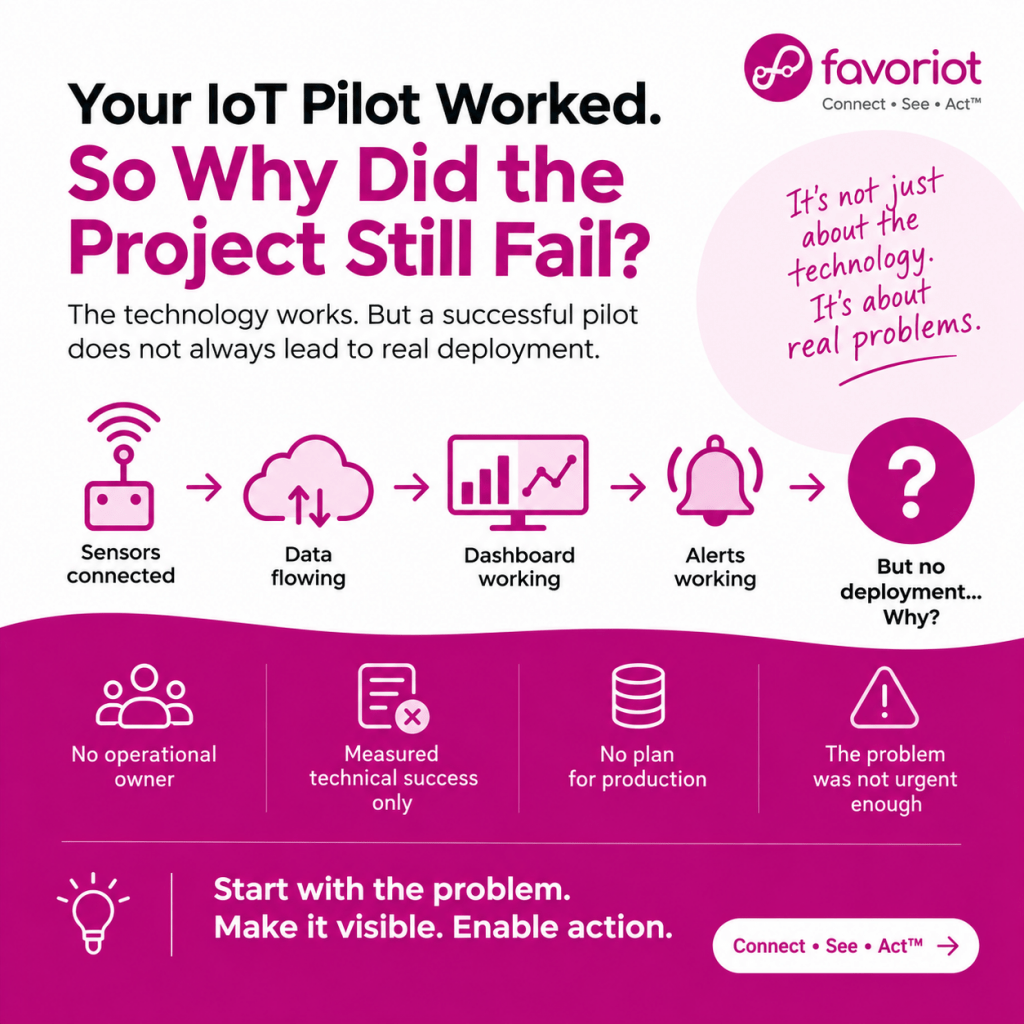
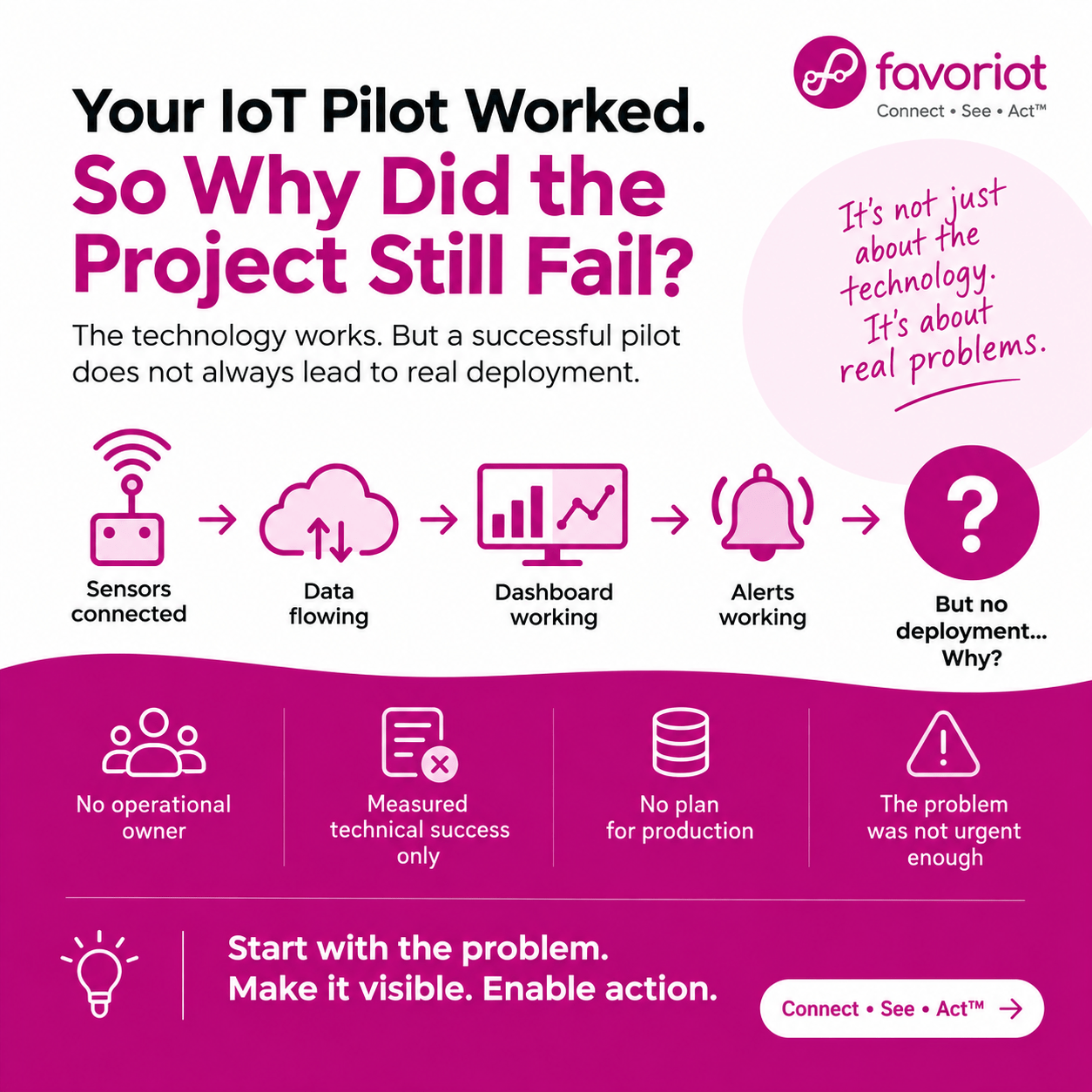
The sensors are connected, data is reaching the cloud, dashboards are displaying information correctly and alerts are being generated. From a technical perspective, the IoT pilot has achieved what it was designed to demonstrate.
Yet this is often the point where the harder part begins.
At FAVORIOT, our experience working with IoT projects has taught us that proving a technology works does not automatically create a reason for an organisation to deploy it across more assets, sites or facilities. A technically successful pilot can still stop because the project has not demonstrated enough operational value to justify what comes next.
This distinction has changed how we believe IoT projects should be approached.
IoT Has Become Much Easier to Build
There was a time when organisations needed considerable technical knowledge just to experiment with IoT. Connecting sensors, configuring communication protocols, sending data to a cloud platform and creating dashboards required specialised skills.
That barrier has fallen considerably. Hardware such as ESP32 and Raspberry Pi is widely available, IoT platforms simplify device connectivity, and developers have access to extensive documentation and examples. Generative AI has lowered the learning barrier further by helping users generate code, troubleshoot errors and understand technical concepts.
Building an IoT prototype is no longer the biggest challenge for many organisations. The more difficult challenge is turning that prototype into something people depend on every day.
The Problem With Starting From Technology
Many IoT projects begin with a technology question: “Can we connect this equipment?”
There is nothing wrong with testing technical feasibility. The problem appears when connectivity becomes the primary measure of success. A pilot may demonstrate that sensors can collect data, MQTT can transport it and a platform can display it, but none of these automatically demonstrates operational value.
A stronger starting point is to ask what the organisation currently cannot see.
Perhaps maintenance teams do not know that a remote pump has stopped until someone visits the site. A facilities manager may not notice abnormal electricity consumption quickly enough. An environmental team may receive information too late to respond effectively, while operators managing remote assets may spend considerable time travelling to locations simply to check whether equipment is functioning.
These are operational problems. IoT is the mechanism for making them visible.
A Pilot Needs an Operational Owner
One of the most important questions should therefore be asked before the pilot begins: Who owns the operational problem?
An IT department may support connectivity and cybersecurity, while an engineering team manages equipment and another department controls the project budget. If nobody has responsibility for the outcome the IoT system is supposed to improve, moving beyond the pilot can become difficult.
The operational owner should be able to explain why the problem matters, what happens when it is not detected early and what action should follow when the IoT system identifies an abnormal condition.
This also changes how pilot success should be measured. Instead of measuring only whether devices connected successfully, organisations can measure whether the project reduced unnecessary site visits, shortened response times, detected problems earlier, reduced downtime or provided better visibility into energy and resource consumption.
The Dashboard Should Not Be the Destination
Dashboards have become almost synonymous with IoT, but a beautiful dashboard does not automatically mean that an organisation has improved its operations.
The more useful question is what happens after someone sees the information.
If a temperature exceeds a threshold, who receives the alert? If equipment suddenly stops, who investigates? If energy consumption becomes abnormal, what action follows? If environmental conditions deteriorate, how quickly can someone respond?
This is the thinking behind FAVORIOT’s Connect → See → Act™ approach. Connecting an asset provides data. Making that information visible creates awareness. Acting on the information is where operational value begins.
Five Questions to Ask Before Starting an IoT Pilot
Before investing in another proof of concept, organisations should be able to answer five practical questions:
- What operational problem are we trying to solve? Define the problem before selecting sensors, devices or platforms.
- What can we not see today? Identify the missing information that prevents faster or better decisions.
- Who owns this problem? There should be someone responsible for the operational outcome, not merely the technology.
- How will we measure success? Include operational measures such as response time, downtime, site visits, losses or resource consumption.
- What happens if the pilot succeeds? Consider production deployment, support, maintenance, connectivity, cybersecurity, budgets and responsibilities before reaching the end of the pilot.
These questions may appear less interesting than discussing sensors, protocols or dashboards, but answering them early can determine whether an IoT project becomes part of daily operations or ends as another demonstration.
From Proof of Technology to Operational Visibility
The IoT industry has spent years proving that connected technology works. We no longer need every project to begin by proving that a sensor can communicate with the cloud. The bigger opportunity is proving that better visibility can improve how an organisation operates.
This is also why FAVORIOT increasingly approaches IoT through the lens of Operational Visibility. The objective is not simply to connect more devices. It is to help organisations see what is happening across physical assets, equipment and environments early enough for people to make better operational decisions.
Before asking “Which sensor should we use?” or “Which IoT platform should we choose?”, there is a more important conversation to have: What operational problem are we trying to make visible, who owns that problem, and what action should happen when we see it?
A pilot that answers those questions has a much stronger reason to continue beyond the demonstration stage. The goal is no longer simply to prove that IoT works. It is to make sure that when the technology works, something meaningful happens because of it.