Posts in IOT PLATFORM

SMART2L System (Smart Water Level and Leakage Detection System)

January 3rd, 2018 Posted by IOT PLATFORM, SMARTCITY 0 thoughts on “SMART2L System (Smart Water Level and Leakage Detection System)”

The Internet of Things (IoT) technology can assist in the effective conservation of resources and energy management. With IoT, managing water level and detecting leakage within water pipeline distribution system can be automated. This is the golden opportunity as the field of water management and distribution progress with the advancement of IoT.

Water shortage has been part of the crucial complications that encountered by many municipalities around the globe and surplus during transmission has been acknowledged as the main problem.

Thus, the key idea for this project is to design a real-time low-cost wireless system called as SMART2L to prevent Non-Revenue Water (NRW) commonly known as unbilled water wastage. SMART2L integrates Internet of Things (IoT) technologies using FAVORIOT platform that will make a change to the way of people live and manage their water resources smartly.

[Note: This project is being done by UNITEN, our FAVORIOT’s University collaborator. Article was written by Haikal Hafiz Kadar]

You can check out the whole LIST of IOT PROJECTS by our University Collaborators.

Monitoring Water Leakage System

January 2nd, 2018 Posted by IOT PLATFORM, SMARTCITY 0 thoughts on “Monitoring Water Leakage System”

Internet of Things (IoT) is a global network of smart devices that can be sensed and interacted with the environment using the internet as a platform for the communication and interaction with other users and systems. The main concept behind every IoT technology and its implementation is “Devices are integrated with the virtual world of internet and interact with it by tracking, sensing and monitoring objects and their environment”.  It also can collect and transmit data, actuate devices based on triggers and receive information.

Water is one of the most important substances for people on earth. Nowadays, people demand something that can influence their daily lifestyle, in a good way. Lots of people do not realize the importance of water because water is a limited resource, but useful in industry and agriculture. By using water monitoring system water wastage can be avoided. Since the water leakage cannot be detected automatically, some of the people do not make a fuss about the problem at all. Thus, the bill of water consumption will increase and this system will help to save cost on the bill, by detecting the leakage of the water at certain points in a pipeline.

Most of the people are unaware of the leakage of water which has been occurred in their environment. Therefore water leakage monitoring system is proposed. Water leakage at certain points can be detected by monitoring flow of water in the pipeline by using Water Flow Sensor. In addition, the amount of water that has been wasted due to the unattended water consumption can be reduced. In order to detect water leakage in the pipeline, the pressure of water will be measured by using the water flow sensor. Once the pressure level is detected,  the LCD will display the current water flow rate and the GSM will notify the user about the­­ leakage.

Flowchart

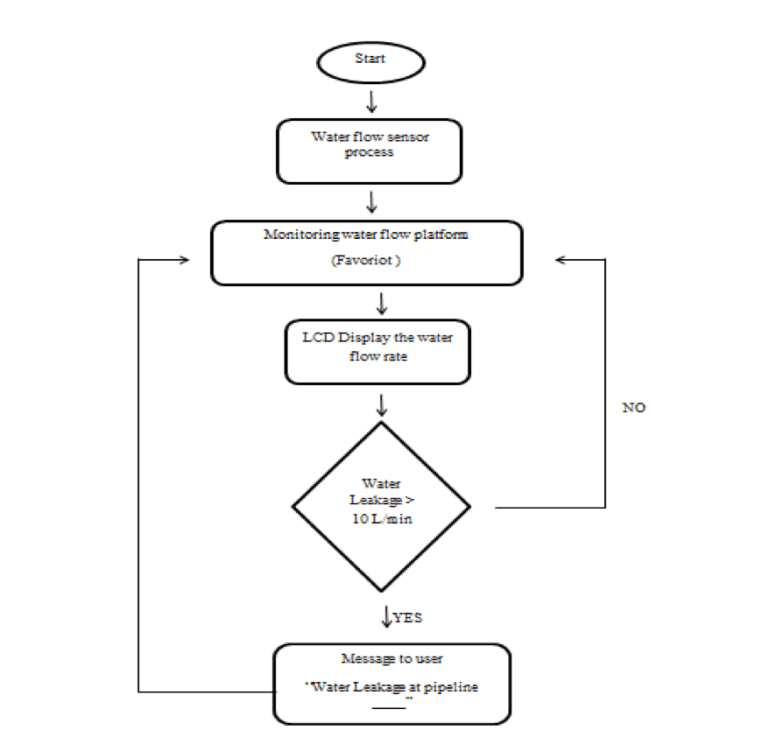
This project is conducted based on the flow chart shown in figure 1. In the first stage, water will go through the water flow sensor and can monitor the water flow by using the Favoriot platform. The LCD will display also the water flow rate.

When the water flow rate more than 10 L/min for a certain time without no one use it to show that the water is leakage. After it detects the leakage occurs at the pipeline, the GSM will notify the user about the leakage.

Figure 1: Flowchart of the monitoring operation

Design Project

The design part of this project, it explained about the process of the monitoring water leakage.

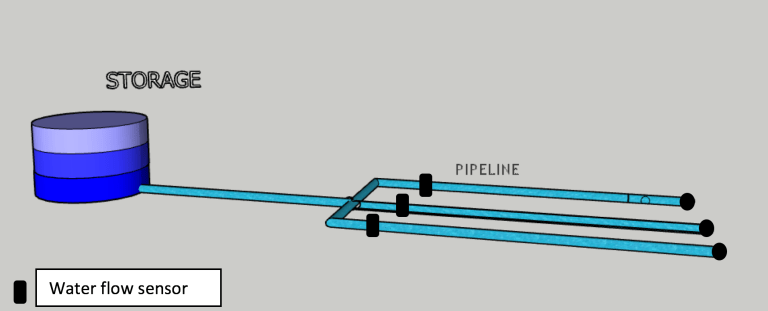
Figure 2: the design project using SketchUp software

Figure 2 shows the concept that will be used in this project. The water from the tank will flow the water to every junction pipeline. And every junction will place the water flow sensor to monitor the flow rate of the water. When the water flow rate increase more than a threshold that was set up, that is mean there is some part is leaking in the pipeline. For monitoring part, Favoriot will monitor the graph of the flow rate water and LCD will show the flow rate value for every second.

[Note: This project is being done by UTHM, our FAVORIOT’s University’s collaborator. Article was written by Mohd Amir Ariff Anuar, FKEE UTHM]

IoT-based Heart Rhythm Monitoring

December 30th, 2017 Posted by IOT PLATFORM 0 thoughts on “IoT-based Heart Rhythm Monitoring”

Abstract

This paper describes the design and implementation of a prototype of IoT based heart rhythm monitoring system in order to get the wave pattern of irregular and normal sinus rhythm of a person that needs a diagnose of having a heart problem and alert the personnel of unusual behavioral reading of beats per minutes (BPM). The system will sense the cardiac rhythm and also identify the user their pulse rate reading in BPM. The system is connected to IoT cloud based where the data is stored and notifies any unusual behavior.


Introduction

Heart rhythm is the signal of heartbeat where it can be view in waveform signal. A normal heart rhythm is called normal sinus rhythm (NSR). An NSR will have a heart rate (pulse) between 50 and 100 beats per minute (BPM) and a normal impulse formation from the SA node (P wave)[1]. Each individual’s normal resting heart rate will vary and can range from 40 to 120, higher in young children. A certain amount of variation in heart rate throughout the day is normal as activity levels vary. Even though an individual’s regular rhythm may not exactly fit, into the category of normal sinus rhythm, it does not necessarily suggest that a problem exists. In addition, even if an individual’s rhythm is normal, it does not preclude underlying heart disease[1].

The graph in Figure 1.1 shows the waveform classification of ECG wave. A normal heartbeat waveform consists a continuous sequence of PQRST waves. The P waves represent a normal heart’s depolarization process. The QRS wave represents the rapid depolarization of the right and the left ventricles. The T wave is generated during the heart ventricle repolarization or recovery[3].

IoT based Heart rhythm monitoring is a system that monitors the rhythm of the user while they at home or outside of a hospital. The device uses to track the pattern of rhythm that changes during everyday life activity. It served as help tool to the doctor to monitor the user without user come to the hospital to undergo tests. In addition, the physician able to real-time monitored the user condition by website application. The changes in heart rate of the user are continuously monitored and detected in form of a value of heartbeat per minute (BPM) and the data that collected is send to the IoT cloud platform and an alert message will be sent to the respective person for further notice if the threshold value set is over limit. Furthermore, the device is designed to be comfortable to the user to wear every day.


Design and Implementation

This section details the implementation system. The system runs in a sequential form: patient – device – server – web application – personnel (doctor).

Figure 2.1: The architecture of monitoring system
Figure 2.2: Flowchart of the system

The system aimed to read the blood flow volume inside the user to read the human pulse or heart rhythm and beat per minute. The sensor used the PPG system where it used reflective type PPG system where the intensity of reflective light received inside the photoresistor is converted into a waveform signal. Thus, the first step is the pulse sensor wrap to the index finger of a user. Secondly, the data transfer from the pulse sensor will undergo algorithm calculation to display the Beat per Minute. In another way, the signal also transfers to the IoT platform for storage and retrieve to the web application to view the displayed of heart rhythm signal.

Figure 2.3: Prototype testing (sensor)

Preliminary Result

This section shows the preliminary result from the prototype testing for waveform pattern for normal people that don’t have a heart problem.

Figure 3.1: A sinus waveform of healthy heart people

The device is connected to the Favoriot platform to store the BPM reading as it will monitor and notify the personnel is unusual BPM reading reads.

Figure 3.2: Data stream on Favoriot platform
Figure 3.3: An alert message received

An alert message will be received when the BPM reading exceeds the threshold value stated.

Conclusion

The prototype is a success in monitoring and notifies the respective personnel in sending an alert when unusual behavior reading is recorded in IoT platform, thus can conclude almost 70% of the project is done.

Future Works

The next step to complete the system is the monitoring of the waveform pattern on the real-time monitor and a comparison between the irregular heartbeat and normal heartbeat. Thus, a web-based application will be created with the help of SQL database to store and compare the waveform pattern with the database of irregular heartbeat get from trusted resources.

References

[1] “Normal Heart Rhythm _ Heart Rhythms _EquiMed Corporation.”
[2] A. Sparshott, “A quick guide to ECG,” IV line, no. 52. pp. 1–2, 2009.
[3] “Remote Heartbeat Monitor [Analog Devices Wiki].” [Online]. Available: https://wiki.analog.com/university/contest/design/sub missions/the_sentinels

[Note: This project is being done by UTHM, our FAVORIOT’s University’s collaborator. Article was written by Siti Nur Hanisah Binti Hamidon, Supervisor: Dr. Ansar Bin Jamil, FKEE UTHM]

You can check out the whole LIST of IOT PROJECTS by our University Collaborators.

Copyright © 2026 All rights reserved