
Posts tagged "Collaborates"

From Final-Year Project to Real-World Pilot: A Favoriot Roadmap

August 28th, 2026 Posted by BLOG, HOW-TO, Internet of Things, IOT PLATFORM 0 thoughts on “From Final-Year Project to Real-World Pilot: A Favoriot Roadmap”

The Gap Nobody Names Out Loud

Most final-year IoT projects die a quiet death. Not because the idea was bad, but because nobody mapped out what happens after the demo. A student builds a working prototype, presents it to a panel, gets a grade, and the device goes into a drawer. The organisation that could have used it never finds out it existed. This is not a motivation problem or a talent problem. It is a missing roadmap, and it is one of the more fixable gaps in how technical education connects to industry.

Favoriot has watched enough student projects go through this cycle to notice a pattern in the ones that do not die in the drawer. They tend to follow a similar four-stage path, whether the project is an environmental sensor network, a predictive maintenance tool, or a smart campus dashboard. Naming that path out loud is the point of this roadmap.

Stage 1: Classroom Foundation

Every real pilot starts as coursework, and that is exactly as it should be. The classroom stage is where a student gets comfortable with device provisioning, data streaming, and dashboard design on a platform that behaves the same way in production as it does in a lab exercise. A few things worth getting right at this stage:

  • Build on infrastructure that will not need to be replaced later. Prototypes built on toy platforms usually get rebuilt from scratch the moment a real organisation shows interest, which wastes months of momentum.
  • Document assumptions early, including what sensors were used, what data intervals were chosen, and why. These decisions get questioned again at the validation stage, and having a clear answer ready saves a lot of back-and-forth.
  • Treat the grading milestone as a checkpoint, not an endpoint. A finished assignment and a finished product are two very different things, and conflating them is where most projects stall.

Stage 2: Site Validation

This is where a project either proves itself or reveals problems that never showed up in a controlled classroom environment. Moving a system onto an actual site, whether that is a factory floor, a farm, or a campus building, exposes it to conditions no lab can fully simulate: patchy connectivity, dust, humidity, or simply a device sitting somewhere nobody remembers to check on.

Favoriot’s role at this stage is largely about instrumentation and support. Project teams get help translating a working prototype into something that can run unattended on real infrastructure, along with monitoring to catch failures before they become embarrassing site visits. Validation at this stage usually answers three questions: does the system keep working without a student standing next to it, does the data it produces hold up against ground truth, and does it survive contact with an environment nobody designed for it.

Stage 3: User Feedback

A system that works technically can still fail completely if the people meant to use it never open the dashboard. This stage is easy to skip because it is less technically interesting than the previous one, but it is often where the most useful revisions happen.

Real users, whether that is a plant supervisor, a farm manager, or a facilities team, tend to ask for things a student would never think to build: a simpler alert threshold, a report formatted for a specific meeting, a mobile view because nobody at the site sits at a desk. Incorporating this feedback is what separates a project that impresses an organisation once from one that gets asked to stay.

Stage 4: Organisational Adoption

The final stage is where a pilot either gets absorbed into how an organisation actually operates or quietly winds down once the semester ends. Adoption depends less on the technology at this point and more on questions like who owns the system now that the student has graduated, what budget covers its continued operation, and whether it integrates with existing workflows rather than sitting beside them as a separate tool.

Projects that reach this stage successfully usually share a few traits:

  1. A named owner inside the organisation, not just an enthusiastic contact who championed the pilot informally.
  2. A clear cost picture, so continuing the system is a budget line rather than a favour someone has to keep asking for.
  3. Integration with an existing decision, such as maintenance scheduling or resource allocation, rather than a standalone dashboard competing for attention.

Signals a Project Is Ready for the Next Stage

Not every project needs to rush through all four stages, and pushing one forward before it is ready usually backfires. A rough gut check for readiness at each transition:

  • Ready to move from classroom to site: the prototype has run for at least a few consecutive days without manual intervention.
  • Ready to move from validation to user feedback: the data being produced has been checked against a real-world reference and holds up.
  • Ready to move from feedback to adoption: at least one real user has asked to keep using the system after the pilot period ends.

That last signal is worth paying attention to. It is a far more reliable indicator of readiness than any grade a panel could give.

Closing the Loop

None of this requires a student to become a business development team. What it requires is a roadmap that exists before the project starts, so momentum built in the classroom does not evaporate the moment the semester does. Favoriot supports project teams through each of these stages, from platform access through to the conversations that turn a pilot into something an organisation actually keeps running.

If a student, supervisor, or department has a project that feels ready to move beyond the classroom, reaching out costs nothing and usually clarifies which stage of this roadmap it is actually standing on.
Building an AIoT Ready University

Build an IoT-ready University That Goes Beyond Lab Projects with Favoriot

May 8th, 2026 Posted by BLOG, Favoriot Insight Framework, HOW-TO, Internet of Things, IOT PLATFORM, Training 0 thoughts on “Build an IoT-ready University That Goes Beyond Lab Projects with Favoriot”
Building an AIoT-Ready University | Favoriot
University Guidebook · AIoT Ecosystem

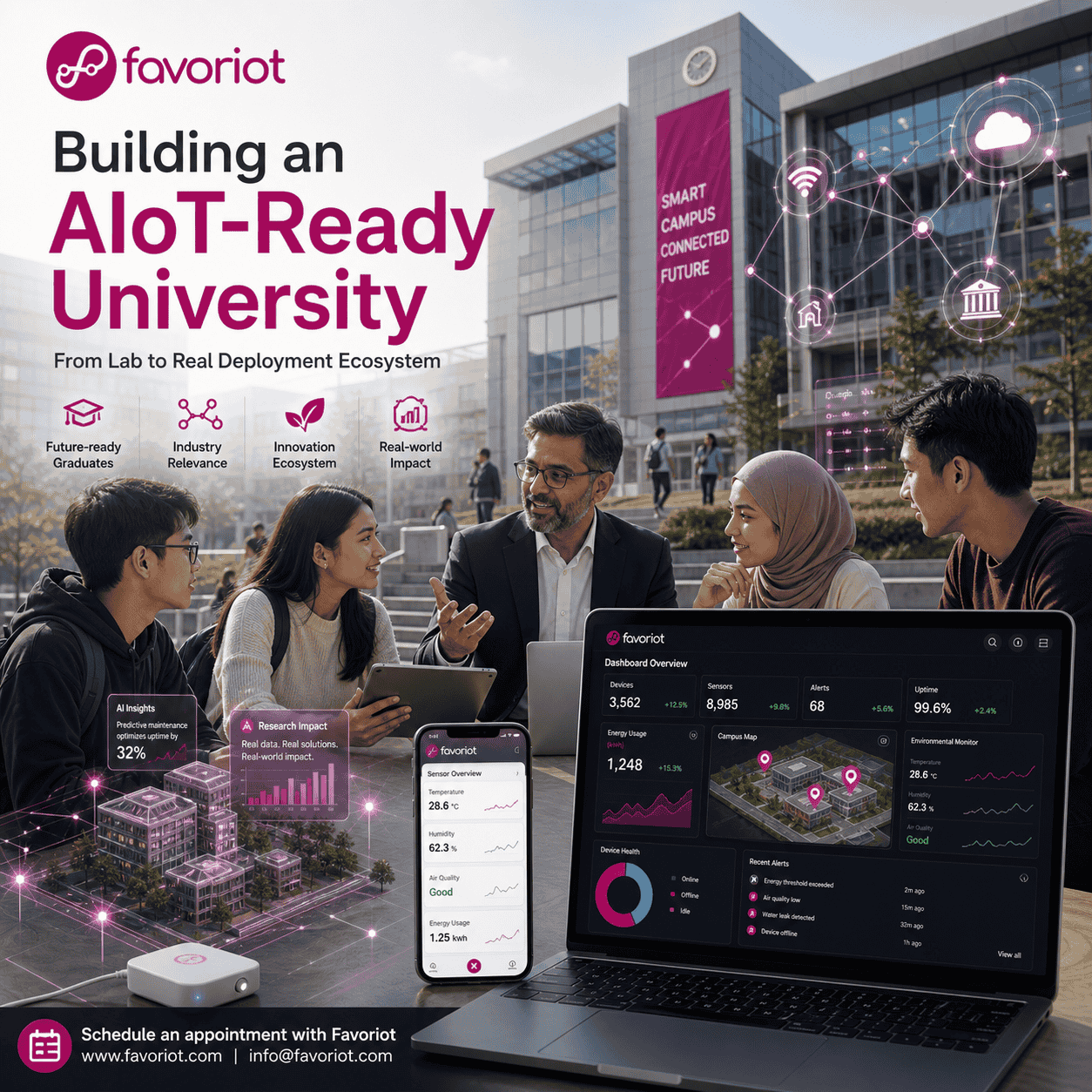
Build an AIoT-ready university that goes beyond lab projects.

Many universities have IoT projects, smart campus initiatives, research grants, and hardworking students. The real issue is that these efforts often live in separate corners. Favoriot helps bring them into one connected platform for teaching, research, industry work, and real deployment.

Future-ready graduates
Industry-relevant projects
Connected research data
AIoT Campus View

A shared platform view for devices, users, dashboards, and alerts.

128Projects
3,562Devices
68Alerts

From scattered projects to one living ecosystem

Favoriot becomes the platform backbone that connects faculties, devices, students, lecturers, researchers, and campus operations.

The real problem

Activity is not the same as connection.

Universities are not short of effort. The gap is usually found between one project and another, between one faculty and another, and between learning and deployment.

What most universities already have

  • IoT projects built by students and researchers.
  • Smart campus pilots that show early promise.
  • Research grants that need real data.
  • Lecturers who want students to build practical systems.
Each faculty runs its own project

Different tools, different dashboards, different device flows, and no shared structure.

Systems do not talk to each other

Data stays trapped inside separate projects instead of becoming useful across the university.

Student work rarely scales

A good final-year project may disappear after presentation day because nobody continues it.

Industry engagement becomes project-based

Without a common platform, collaboration depends too much on individual effort.

Why does everything feel active, but not connected?
The Favoriot role

The platform backbone for a connected AIoT university.

Favoriot helps universities create a shared environment where projects can grow, data can be reused, and students can learn from real deployment instead of one-off experiments.

Connect everything

Bring devices, sensors, dashboards, users, faculties, and projects into one university-wide platform.

Build continuity

Allow students and lecturers to build on previous work instead of restarting from zero every semester.

Create real outcomes

Support smart campus use cases, research data collection, industry projects, and future-ready graduate development.

The plan

Seven areas universities must get right.

The guide helps leadership, deans, faculty heads, research teams, and lecturers move from scattered IoT activity to a connected AIoT ecosystem.

1

Why universities struggle with IoT adoption

Projects remain isolated. There is little continuity between semesters. Effort grows, but impact stays limited.

2

Creating a unified IoT platform across faculties

Standardise tools, improve collaboration, and reuse previous work across engineering, agriculture, environment, and smart campus initiatives.

3

Building an IoT and AIoT lab that scales

Enable multiple students to work at the same time with real-time monitoring and simple onboarding.

4

Connecting students, lecturers, and industry

Industry defines the problem. Lecturers guide the solution. Students build and test. The platform connects the work.

5

Research opportunities with real data

Collect continuous data, replay trends, build predictive models, and validate ideas with real inputs.

6

Monetising university AIoT work

Turn projects into solutions, consulting packages, partnerships, training programmes, and market-ready pilots.

7

Preparing students for industry

Help students understand systems, deploy solutions, solve real problems, and graduate with confidence.

The bigger shift

Not another dashboard. A connected learning and deployment ecosystem.

A dashboard is useful, but a university needs more than screen displays. It needs a system where each project strengthens the next one. That is how teaching, research, and industry engagement start to move together.

  • Projects build on each other
  • Research becomes stronger
  • Industry engagement deepens
  • Students graduate with real deployment experience
Failure versus success

The difference is not effort. The difference is connection.

Without a common platform, universities stay busy but disconnected. With Favoriot, the work can finally compound.

What failure looks like

Failure does not always look dramatic. Sometimes it looks like normal academic activity that never grows into lasting value.

  • ×Student projects disappear after final presentation day.
  • ×Lecturers repeat the same setup every semester.
  • ×Research data is collected manually and forgotten.
  • ×Faculties work hard, but separately.
  • ×Smart campus initiatives remain small pilots.

What success looks like

Success looks like a university where learning, research, and deployment are part of the same connected system.

  • Students continue and improve previous projects.
  • Lecturers supervise projects inside a shared platform.
  • Researchers collect continuous real-time data.
  • Industry partners see clearer value from university work.
  • Graduates leave with real AIoT deployment experience.
Schedule an appointment

Ready to build an AIoT-ready university with Favoriot?

Talk to us about how your university can connect students, lecturers, researchers, devices, data, and industry projects into one practical AIoT ecosystem.

From Environmental Monitoring to Predictive Public Health: A Favoriot Case Study on Dengue Forecasting

This IoT Project Predicted Dengue Before It Happened – A Favoriot Success Story

March 27th, 2026 Posted by BLOG, HOW-TO, Internet of Things, IOT PLATFORM 0 thoughts on “This IoT Project Predicted Dengue Before It Happened – A Favoriot Success Story”

Introduction

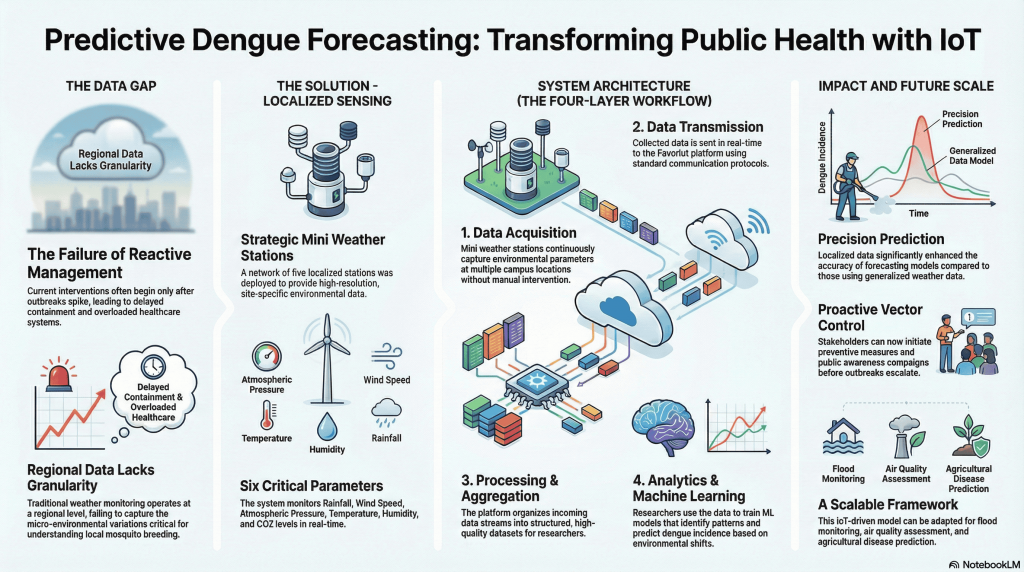
Dengue fever continues to pose a significant public health challenge in Malaysia and across many tropical regions. While efforts to manage outbreaks have improved over the years, most interventions remain reactive, often initiated only after cases begin to rise. This delay reduces the effectiveness of containment measures and increases the burden on healthcare systems.

What if outbreaks could be anticipated earlier?

What if environmental signals could be translated into actionable insights before infections spike?

This case study examines how a Malaysian university leveraged the Favoriot platform to enhance its research capabilities in predicting dengue outbreaks. By combining localised environmental monitoring with data analytics and machine learning, the university transitioned from general observation to data-driven prediction.

The Objective: Enabling Predictive Research

The university’s primary objective was to strengthen its research in dengue prediction by collecting localised environmental data. Rather than relying solely on generalised weather reports, the goal was to establish a system to capture real-time, site-specific environmental conditions that influence mosquito breeding and virus transmission.

This initiative aimed to:

  • Improve the accuracy of dengue prediction models
  • Provide researchers with high-quality, continuous datasets
  • Support early warning mechanisms for public health intervention

The Challenge: Limited Granularity in Environmental Data

One of the key challenges faced by the university was the lack of detailed and localised weather data.

Traditional weather monitoring systems typically operate at a regional level. While useful for general forecasting, they often fail to capture micro-environmental variations that are critical in understanding dengue dynamics.

Specifically, the university required:

  • High-resolution data across multiple locations
  • Real-time data availability for timely analysis
  • Integration of multiple environmental parameters in a single system

Without these capabilities, predictive modelling would remain limited in accuracy and reliability.

The Solution: Localised IoT-Enabled Weather Monitoring

To address these challenges, Favoriot deployed a network of mini weather stations across strategic locations within and around the university campus.

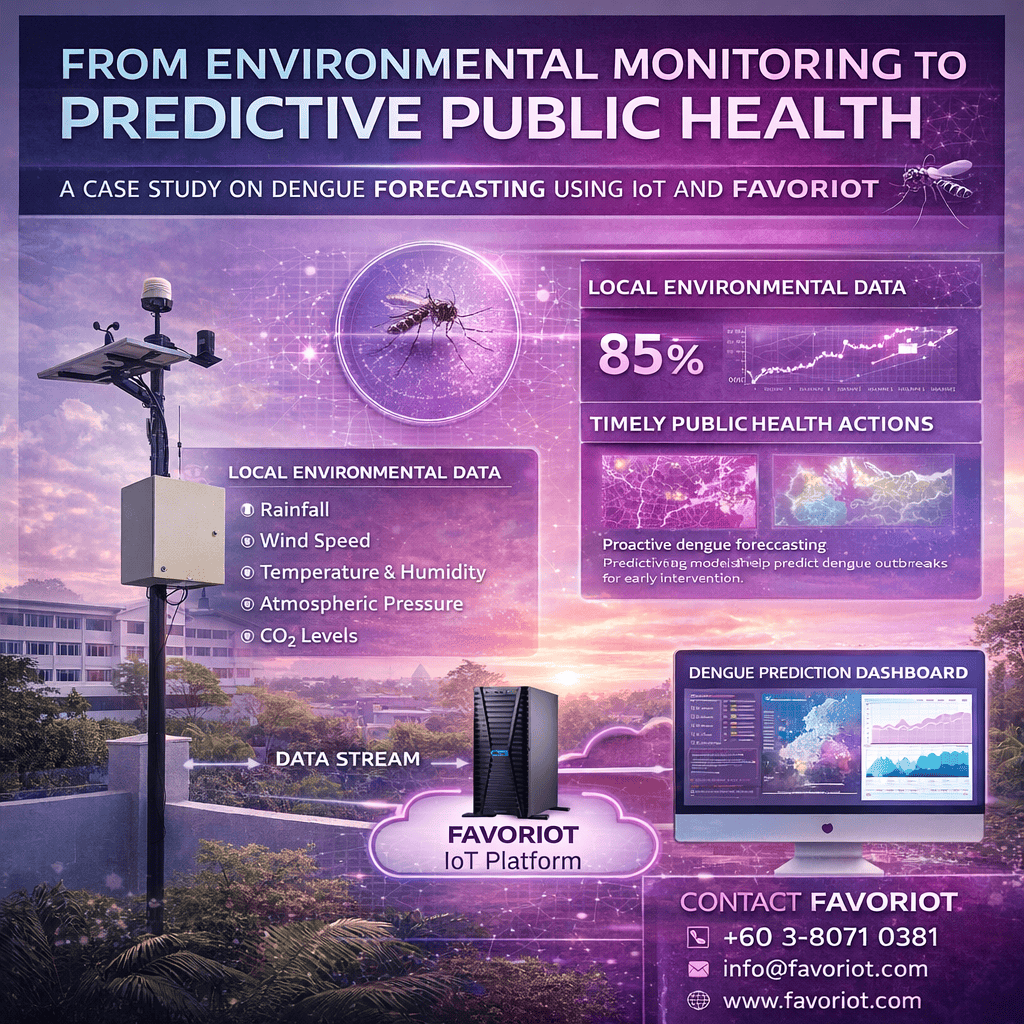
Each station was equipped with sensors capable of measuring:

  • Rainfall
  • Wind speed
  • Atmospheric pressure
  • Temperature
  • Humidity
  • Carbon dioxide levels

These stations continuously collected environmental data and transmitted it to the Favoriot IoT platform for centralised processing and analysis.

This approach ensured that data was collected at the source, providing a more accurate reflection of local environmental conditions.

System Architecture: From Data Acquisition to Insight

The overall system architecture can be described in four key layers:

1. Data Acquisition

Mini weather stations continuously capture environmental parameters at multiple locations. This ensures consistent and reliable data input without manual intervention.

2. Data Transmission

Collected data is transmitted in real time to the Favoriot platform using standard communication protocols, enabling immediate availability for analysis.

3. Data Processing and Aggregation

The Favoriot platform aggregates incoming data streams, organises them into structured datasets, and prepares them for analytical processing.

4. Analytics and Machine Learning

Researchers utilise the processed data to develop and train machine learning models. These models identify patterns and correlations between environmental conditions and dengue incidence, improving prediction accuracy over time.

Implementation: Structured Deployment and Data Utilisation

The implementation of the system followed a systematic approach:

  • Strategic Deployment: Five mini weather stations were installed in carefully selected locations to ensure optimal data coverage.
  • Continuous Data Collection: Sensors operated continuously, providing real-time environmental data streams.
  • Centralised Data Management: All data was ingested and managed through the Favoriot platform.
  • Research Integration: Data was made accessible to researchers for analysis, modelling, and validation of predictive algorithms.

This structured deployment ensured that the system was both scalable and aligned with the university’s research objectives.

Results: Measurable Improvements in Prediction and Response

The deployment delivered several key outcomes:

Improved Data Accuracy

Localised data collection significantly enhanced the precision of environmental measurements. This allowed researchers to work with more reliable datasets compared to traditional sources.

Enhanced Predictive Modelling

Machine learning models trained on high-quality, localised data demonstrated improved performance in predicting dengue outbreaks. The ability to capture micro-environmental variations contributed to more accurate forecasting.

Support for Proactive Public Health Measures

With improved prediction capabilities, stakeholders can initiate preventive actions earlier. This includes targeted vector control measures, public awareness campaigns, and resource allocation before outbreaks escalate.

Key Insights: Moving Beyond Data Collection

This case highlights an important shift in how IoT is applied in research and public health.

The value of IoT does not lie solely in data collection, but in its ability to:

  • Provide context-rich, localised data
  • Enable continuous monitoring
  • Support advanced analytics and predictive modelling
  • Drive informed decision-making

By connecting environmental data to actionable insights, the university elevated its research from observation to prediction.

Broader Implications: A Scalable Model for Other Domains

The approach demonstrated in this project can be extended beyond dengue prediction.

Similar frameworks can be applied to:

  • Flood monitoring and early warning systems
  • Air quality assessment in urban areas
  • Agricultural disease prediction
  • Urban climate analysis

In each case, the combination of localised sensing, real-time data processing, and intelligent analytics can significantly improve outcomes.

Conclusion

This case study demonstrates how integrating IoT and data analytics can enhance research capabilities and drive real-world impact.

By deploying localised weather stations and leveraging the Favoriot platform, the university successfully improved its ability to predict dengue outbreaks. The result is not only better research outcomes but also a stronger foundation for proactive public health strategies.

The transition from reactive response to predictive insight represents a meaningful step forward in managing complex health challenges.

For Further Inquiry

Organisations interested in developing similar solutions for environmental monitoring, predictive analytics, or smart city applications are encouraged to connect with Favoriot:

Engage with Favoriot to explore how data can be transformed into actionable intelligence for your specific use case.

Copyright © 2026 All rights reserved