
Executive Overview
Cultural institutions such as national museums carry a critical responsibility to preserve artefacts that represent a nation’s identity, history, and legacy. These artefacts are often fragile and highly sensitive to environmental conditions. Even minor fluctuations in temperature, humidity, or light exposure can lead to irreversible deterioration.
This case study examines how Favoriot, an AIoT platform provider, enabled a leading national museum to strengthen artefact preservation through continuous environmental monitoring, real-time alerts, and data-driven decision-making. The deployment highlights how IoT can move beyond basic data collection to deliver meaningful outcomes in heritage conservation.
The Preservation Challenge
Museums operate under a constant and often underestimated threat. While catastrophic events are rare, the gradual impact of environmental instability poses a continuous risk.
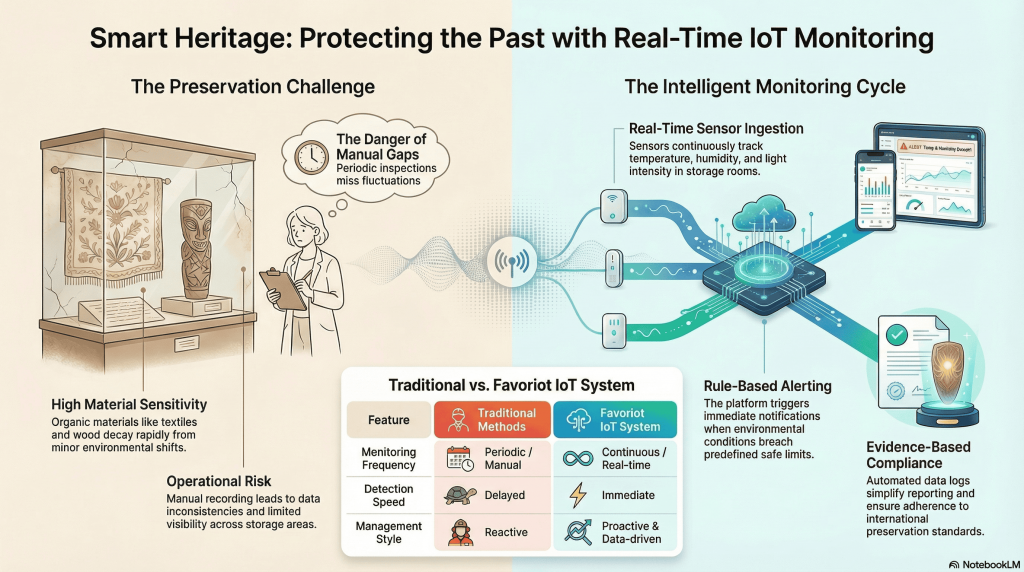
Artefacts made from paper, textiles, wood, and organic materials are particularly vulnerable. Slight changes in humidity can result in mold or structural distortion. Temperature fluctuations can accelerate degradation. Exposure to inappropriate lighting conditions can cause fading and long-term damage.
Traditional preservation approaches typically rely on periodic inspections and standalone monitoring devices. These methods present several limitations:
- Environmental changes may go undetected between inspection intervals
- Manual recording can lead to inconsistencies
- Limited visibility across storage areas
- Challenges in maintaining accurate compliance records
As collections grow and preservation standards become more stringent, these limitations increase operational risk.
Objective of the Deployment
The museum aimed to establish a system capable of continuously monitoring environmental conditions within storage rooms where precious and priceless artefacts are preserved.
The key objectives included:
- Real-time monitoring of temperature, humidity, and light levels
- Immediate detection of deviations from safe thresholds
- Automated alerts to support rapid corrective action
- Centralised data management for analysis and reporting
- Compliance with international preservation standards
The focus was clear. Protect the most valuable artefacts at their most critical location, the storage environment.
Solution Architecture
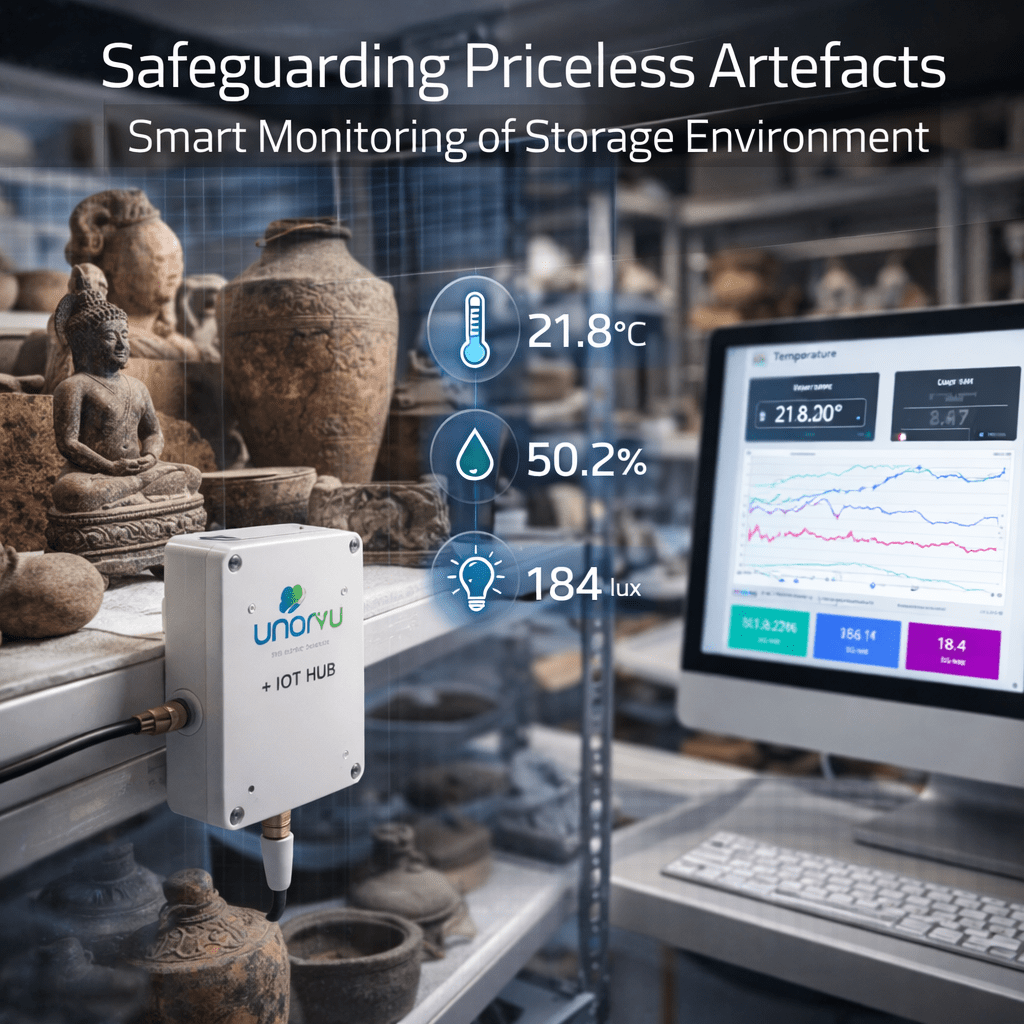
Favoriot deployed a Smart Environment Monitoring System using IoT sensors integrated with its platform.
Sensor Deployment in Storage Rooms
Environmental sensors were installed exclusively within storage rooms, where the most valuable and sensitive artefacts are kept.
These sensors continuously measured:
- Temperature
- Humidity
- Light intensity
By focusing on storage areas, the system ensured that the highest-risk environments received constant and precise monitoring.
Data Transmission and Processing
Sensor data was transmitted in real time to the Favoriot platform. The platform enabled:
- Continuous data ingestion and secure storage
- Monitoring against predefined environmental thresholds
- Rule-based alert generation
- Visualisation through dashboards for operational awareness
Alert Mechanism
The system was configured to trigger alerts whenever environmental conditions moved outside safe limits. Notifications were sent directly to responsible personnel, enabling immediate intervention.
This ensured that corrective action could be taken before any damage to artefacts occurred.
Implementation Approach
The implementation followed a structured process:
- Identification of Critical Storage Areas
Storage rooms housing high-value artefacts were prioritised. - Sensor Installation and Calibration
Devices were installed and calibrated to ensure accurate measurements. - Platform Integration
Sensors were connected to the Favoriot platform for centralised monitoring. - Threshold Definition
Acceptable environmental ranges were defined based on conservation standards. - Alert Workflow Configuration
Notification systems were established for rapid response. - Training and Handover
Museum staff were trained to interpret alerts and manage the system effectively.
Key Outcomes
The deployment delivered clear and measurable benefits:
1. Continuous Protection of Priceless Artefacts
Storage environments were monitored continuously, ensuring that artefacts remained within optimal preservation conditions at all times.
2. Faster Response to Environmental Changes
Real-time alerts enabled immediate corrective action, significantly reducing the risk of prolonged exposure to harmful conditions.
3. Structured Data Management
The system provided consistent and reliable data collection, allowing:
- Historical trend analysis
- Early identification of recurring issues
- Data-driven decision-making
4. Strengthened Compliance and Accountability
The platform generated accurate environmental records, supporting compliance with international preservation standards and audits.
5. Improved Operational Focus
Automation reduced reliance on manual checks, allowing staff to focus on conservation and curatorial work.
From Monitoring to Preventive Protection
A key shift in this deployment is the transition from periodic inspection to continuous preventive protection.
Traditional systems often focus on recording conditions. This approach introduces delays between detection and response.
Favoriot enables:
- Immediate detection of anomalies
- Automated alerting mechanisms
- Timely intervention before damage occurs
This transforms monitoring into an active safeguarding process.
Strategic Implications for Museums
This case highlights several important considerations for cultural institutions:
Continuous Monitoring is Essential
Periodic inspections alone cannot guarantee stable preservation conditions, especially for high-value artefacts stored in controlled environments.
Data Must Enable Action
Environmental data must be actionable. Without alert mechanisms and response workflows, its value is limited.
Evidence-Based Preservation Matters
Maintaining accurate records is critical for compliance, reporting, and institutional credibility.
Focus on High-Risk Areas
Targeting storage rooms where priceless artefacts are kept ensures that resources are directed to the most critical environments.
The Favoriot Value Proposition
Favoriot’s role in this project can be summarised through three core strengths:
- Integrated Platform
A unified system for monitoring, analytics, and alerting - Real-Time Responsiveness
Immediate detection and notification of environmental deviations - Outcome-Focused Deployment
Emphasis on protecting artefacts rather than simply displaying data
This approach aligns with the increasing demand for solutions that deliver measurable impact rather than standalone features.
Conclusion
Preserving cultural heritage requires continuous attention, precision, and reliability. Artefacts stored in controlled environments depend on stable conditions that must be maintained at all times.
Through its IoT-based Smart Environment Monitoring System, Favoriot enabled the museum to shift from reactive preservation practices to proactive environmental control, specifically in storage rooms where priceless artefacts are kept.
The result is enhanced protection, improved operational confidence, and stronger compliance with preservation standards.
This case demonstrates that when technology is applied with purpose, it becomes an essential safeguard for history itself.
The real question for cultural institutions is simple.
How long can priceless artefacts remain protected without a system that continuously watches over them?
Contact
Contact Favoriot for further inquiry.