
Posts by favoriot

Smart Cities and Favoriot

Widely Adopted Smart City Applications

February 9th, 2026 Posted by BLOG, HOW-TO, Internet of Things, IOT PLATFORM 0 thoughts on “Widely Adopted Smart City Applications”

Priorities, Implementation Challenges, and Practical Responses

Executive Summary

Cities worldwide are turning to smart city technologies to cope with rising urban demands, ageing infrastructure, and tighter operational budgets. While smart city visions often span many domains, real-world deployments show a consistent starting point. Most cities begin with a small set of applications that solve visible, operational problems and can be justified through clear outcomes.

This paper examines the three smart city application areas most commonly deployed globally and explains not only why they are prioritised, but also the key challenges cities face during implementation and practical approaches to overcoming them.

1. Smart Mobility and Traffic Management

Purpose and scope

Smart mobility systems focus on improving traffic flow, reducing congestion, and enhancing safety across urban road networks. Typical deployments include adaptive traffic signals, traffic flow monitoring, smart parking systems, and real-time visibility into public transport.

These systems rely on data collected from sensors, cameras, and transport assets to support operational decisions at both junction and network levels.

Why cities prioritise mobility

Traffic congestion directly affects productivity, fuel consumption, air quality, and emergency response. It is also highly visible to residents, making it a frequent political and operational concern.

Mobility projects are often prioritised because they deliver measurable results quickly, such as reduced waiting times or improved junction throughput. Existing road infrastructure also provides clear and accessible locations for sensor deployment.

Key challenges

Cities often encounter several issues when deploying smart mobility solutions:

  • Fragmented systems where traffic, parking, and public transport operate independently
  • Over-reliance on visual dashboards without linking insights to field operations
  • Limited data quality due to inconsistent sensor placement or calibration
  • Difficulty scaling pilot projects beyond selected corridors

Practical approaches

To address these challenges, cities should:

  • Begin with high-impact routes or congestion hotspots rather than attempting city-wide coverage
  • Link traffic alerts and insights directly to traffic control rooms and enforcement teams
  • Standardise data collection methods across sensors and systems
  • Design solutions with expansion in mind, allowing additional intersections and corridors to be added incrementally

2. Smart Energy and Utilities Management

Purpose and scope

Smart utility systems aim to improve visibility and control over electricity, water, and public infrastructure consumption. Typical applications include smart metering, street lighting control, water leak detection, and energy monitoring in public buildings.

These systems help cities understand where resources are consumed, wasted, or underperforming.

Why cities prioritise utilities

Utilities represent a large and recurring operational expense for municipalities. Energy losses, water leakage, and inefficient lighting often go unnoticed without continuous monitoring.

Smart utility projects are also closely linked to sustainability targets, climate commitments, and national energy reporting requirements, thereby strengthening their business case.

Key challenges

Common challenges in utilities deployments include:

  • Legacy infrastructure is not designed for digital monitoring
  • Data overload without clear thresholds or response actions
  • Limited coordination between utilities, facilities, and maintenance teams
  • Difficulty demonstrating savings without a clear baseline

Practical approaches

Cities can reduce these risks by:

  • Starting with assets that have known issues or high operating costs
  • Establishing baseline consumption measurements before optimisation
  • Defining clear alert thresholds and maintenance response workflows
  • Integrating operational monitoring with long-term reporting for finance and sustainability teams

3. Public Safety and Urban Surveillance

Purpose and scope

Public safety systems enhance situational awareness and support faster, better-coordinated responses to incidents. Typical deployments include CCTV networks, incident detection systems, emergency response coordination tools, and integrated command centres.

These systems are designed to support prevention, early detection, and response.

Why cities prioritise safety

Safety is a core responsibility of city authorities. Technologies that reduce response times and improve coordination across agencies are often treated as essential infrastructure.

Public safety projects also tend to receive public support when benefits such as faster emergency response and improved accountability are clearly demonstrated.

Key challenges

Public safety deployments often face:

  • Fragmentation between police, fire, medical, and city operations
  • High volumes of data require constant human monitoring
  • Privacy concerns and unclear governance structures
  • Technology deployments without agreed response procedures

Practical approaches

Effective public safety systems require:

  • Clearly defined response protocols before system activation
  • Integration across agencies rather than isolated deployments
  • Governance policies covering access control, data retention, and oversight
  • A shift from continuous monitoring to event-driven alerts that prompt action

Cross-Cutting Challenges Across Smart City Applications

Across all three application domains, cities commonly face shared issues:

  • Siloed systems managed by different departments or vendors
  • Difficulty scaling pilots into operational city-wide systems
  • Limited reuse of data across departments
  • Dependence on dashboards without operational integration

These challenges often stem from technology-first deployments that lack a unified operational strategy.

Platform Strategy as an Enabler

A shared IoT platform approach helps cities manage multiple applications within a consistent operational framework. This enables standardised data ingestion, common alerting rules, and shared access controls across departments.

Platforms such as FAVORIOT support multi-domain deployments by enabling cities to manage mobility, utilities, and safety use cases within a single environment while retaining the flexibility to grow and adapt over time.

Closing Perspective

Smart mobility, smart utilities, and public safety systems are widely adopted because they solve real problems and deliver measurable outcomes. Their success depends not only on technology, but on careful planning, phased deployment, and strong operational alignment.

Cities that address implementation challenges early and adopt a scalable platform strategy are better positioned to move from isolated projects toward coordinated, data-informed urban management.


Favoriot Launches Lite Plan to Support Students, Beginners, and Early IoT Builders

Favoriot Launches Lite Plan to Support Students, Beginners, and Early IoT Builders

January 25th, 2026 Posted by BLOG, CAMPAIGN, Internet of Things, IOT PLATFORM, NEWS 0 thoughts on “Favoriot Launches Lite Plan to Support Students, Beginners, and Early IoT Builders”

FOR IMMEDIATE RELEASE

Kuala Lumpur, 23 January 2026
Favoriot today announced the launch of its new Lite Plan, a lower-entry subscription designed to help students, educators, beginners, startup founders, and developers begin their IoT journey using a real, production-grade platform.

The Lite Plan addresses a growing need for a simple, affordable way to connect devices, view data, and understand IoT workflows without the complexity often found in larger, enterprise-focused plans. Users on the Lite Plan gain access to the same core Favoriot platform used by commercial and government deployments, scaled to suit learning, experimentation, and early validation.

The Lite Plan is about removing friction at the starting line,” said Dr. Mazlan Abbas, Co-Founder and CEO of Favoriot. “Many users want to learn or test ideas with real devices and real data, but do not need advanced features yet. This plan gives them a proper foundation without overcommitment.”

Designed for Specific User Segments

The Lite Plan is best suited for:

  • Students and educators working on coursework, labs, or final-year projects who need hands-on experience with an industry platform
  • IoT beginners using devices such as ESP32 or Arduino and learning basic device-to-cloud data flows
  • Startup teams and founders building proofs of concept or early prototypes
  • Developers and technologists evaluating IoT platforms before selecting a long-term solution

Clear Progression Across Plans

Favoriot positions the Lite Plan as a starting point within its broader subscription structure:

  • Lite Plan: Entry-level access for learning, testing, and early exploration
  • Beginner Plan: Expanded usage for wider testing and multiple devices
  • Developer Plan: Application development, integrations, and pilot deployments
  • Professional and Enterprise Plans: Full-scale production, security controls, and operational workflows

Users can upgrade plans as their projects grow, with continuity across devices and data.

Availability

The Favoriot Lite Plan is available immediately. Full pricing and plan details can be found at:
https://www.favoriot.com/iotplatform/pricing/

About Favoriot
Favoriot is a Malaysia-based IoT and AIoT platform provider supporting smart city, agriculture, manufacturing, education, and enterprise use cases. The platform enables secure device management, real-time data ingestion, analytics, and automation for organisations at every stage of adoption.

Media Contact
Favoriot Communications Team
https://www.favoriot.com

man standing beside people sitting beside table with laptops

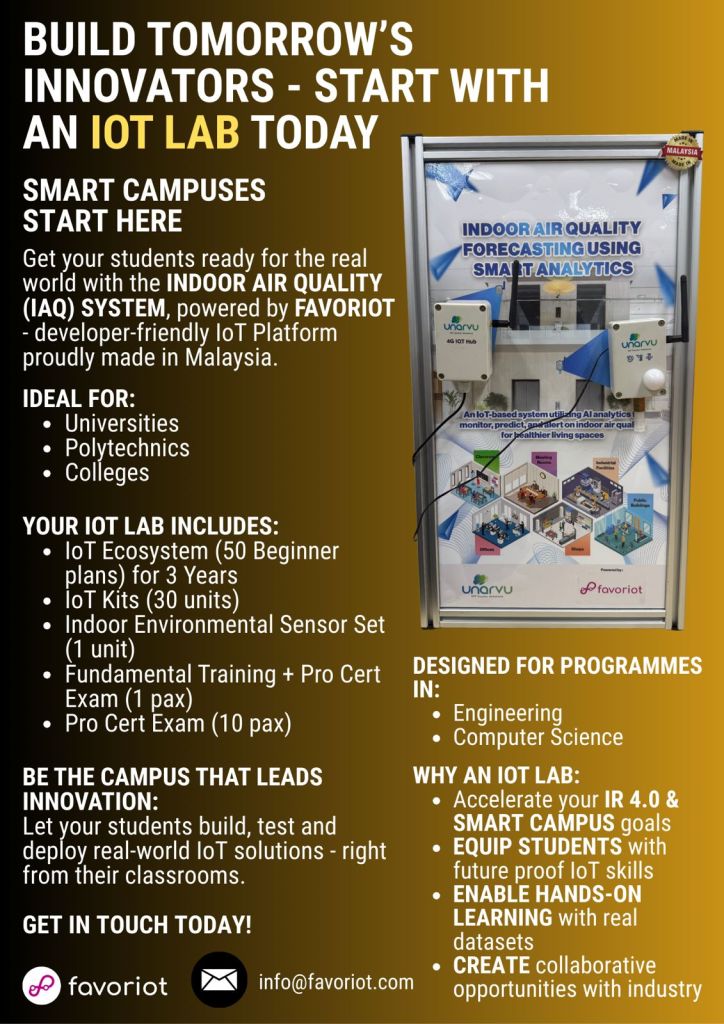
FAVORIOT IoT Certification and IoT Lab for Universities – Bridging Academia and Industry

October 1st, 2025 Posted by BLOG, HOW-TO, Internet of Things, IOT PLATFORM, Training 0 thoughts on “FAVORIOT IoT Certification and IoT Lab for Universities – Bridging Academia and Industry”

1. Introduction

The future workforce needs more than theory; it requires hands-on, industry-driven skills. Universities worldwide are racing to prepare students for the Fourth Industrial Revolution (IR 4.0), where the Internet of Things (IoT) plays a central role. However, many institutions struggle with two challenges:

  1. Lack of industry-aligned certifications that make graduates more employable.
  2. Insufficient access to real-world IoT systems and labs that allow students to build, test, and deploy solutions.

FAVORIOT bridges this gap through IoT Certifications and the IoT Lab Package, ensuring that students graduate with both academic credentials and industry-recognised certifications.

2. IoT Certifications with Universities

FAVORIOT collaborates with higher education institutions to integrate IoT certifications into their programs. The entry requirement is that lecturers must first be certified as FAVORIOT Certified Trainers by passing the FAVORIOT Professional Certificate Exam.

Once certified, lecturers can offer students two methods to earn industry certification:

  1. Conduct Similar Training for Students
    • Students undergo the same structured training.
    • Upon completion, they can earn either:
      • Completion Certificate, or
      • A Professional Certificate (via exam), which is optional but offers higher industry recognition.
  2. Embed Certification into the IoT Syllabus
    • Certification modules (theory + hands-on lab sessions) are integrated directly into the university’s IoT courses.
    • Students earn credit hours and have the option to pursue industry certification.

This dual pathway ensures flexibility, allowing universities to either treat certification as a standalone program or seamlessly embed it into existing curricula.

3. The FAVORIOT IoT Lab Package

To simplify the certification rollout, FAVORIOT offers a turnkey IoT Lab Package, designed to provide institutions with everything needed to deliver hands-on IoT education.

Components of the IoT Lab:

  • IoT Ecosystem (50 Beginner Plans for 3 Years)
    • A cloud-based platform for managing IoT devices, data, and applications.
    • Multiple student accounts can be created for coursework, lab experiments, and final year projects.
    • Accounts are recyclable and reusable within the contract period—ensuring cost efficiency while supporting new batches of students each semester.
  • IoT Kits (30 Units)
    • Ready-to-use development kits with sensors and connectivity modules.
    • Enable students to prototype IoT solutions rapidly.
  • Indoor Environmental Sensor Set (1 Unit)
    • Smart Environmental System that monitors real-world conditions such as air quality.
    • Demonstrates how IoT is applied in commercial settings (e.g., smart buildings, healthcare, and smart campuses).
  • Training and Certifications
    • Fundamental IoT Training + Pro Cert Exam (1 pax) – equips one faculty member with mastery of the FAVORIOT platform.
    • Professional Certificate Exams (10 pax) – bundled for students, ensuring the first cohort can be industry certified.

4. Value Proposition to Universities

By adopting the FAVORIOT IoT Certification and Lab, universities can:

  • Differentiate Their Programs
    • Offering IoT certification adds value beyond the degree. Graduates gain both academic qualifications and industry credentials.
  • Enhance the Employability of Students
    • Students graduate with skills recognised by industry, improving their chances of securing jobs in engineering, computer science, and technology sectors.
  • Support Final Year Projects (FYP)
    • Students can use the IoT ecosystem to manage data, build dashboards, and integrate hardware for their capstone projects.
  • Future-Proof Curriculum
    • Embedding real-world IoT systems into labs keeps academic programs aligned with industry needs.
  • Accelerate IR 4.0 and Smart Campus Goals
    • Universities demonstrate leadership by building smart campuses that embody the principles they teach.

5. Conclusion

FAVORIOT empowers universities to transform their IoT education strategy. By combining lecturer certificationstudent certification pathways, and the IoT Lab package, institutions can deliver industry-relevant, hands-on, and certifiable IoT skills to their students.

This model ensures that students graduate not only with theoretical knowledge but also with the confidence, tools, and certifications necessary to thrive in the rapidly growing IoT job market.

Next Step for Universities:
Adopt the FAVORIOT IoT Lab and Certification program to position your campus as a leader in innovation, producing graduates ready to build and lead in the IoT economy.

Copyright © 2026 All rights reserved