
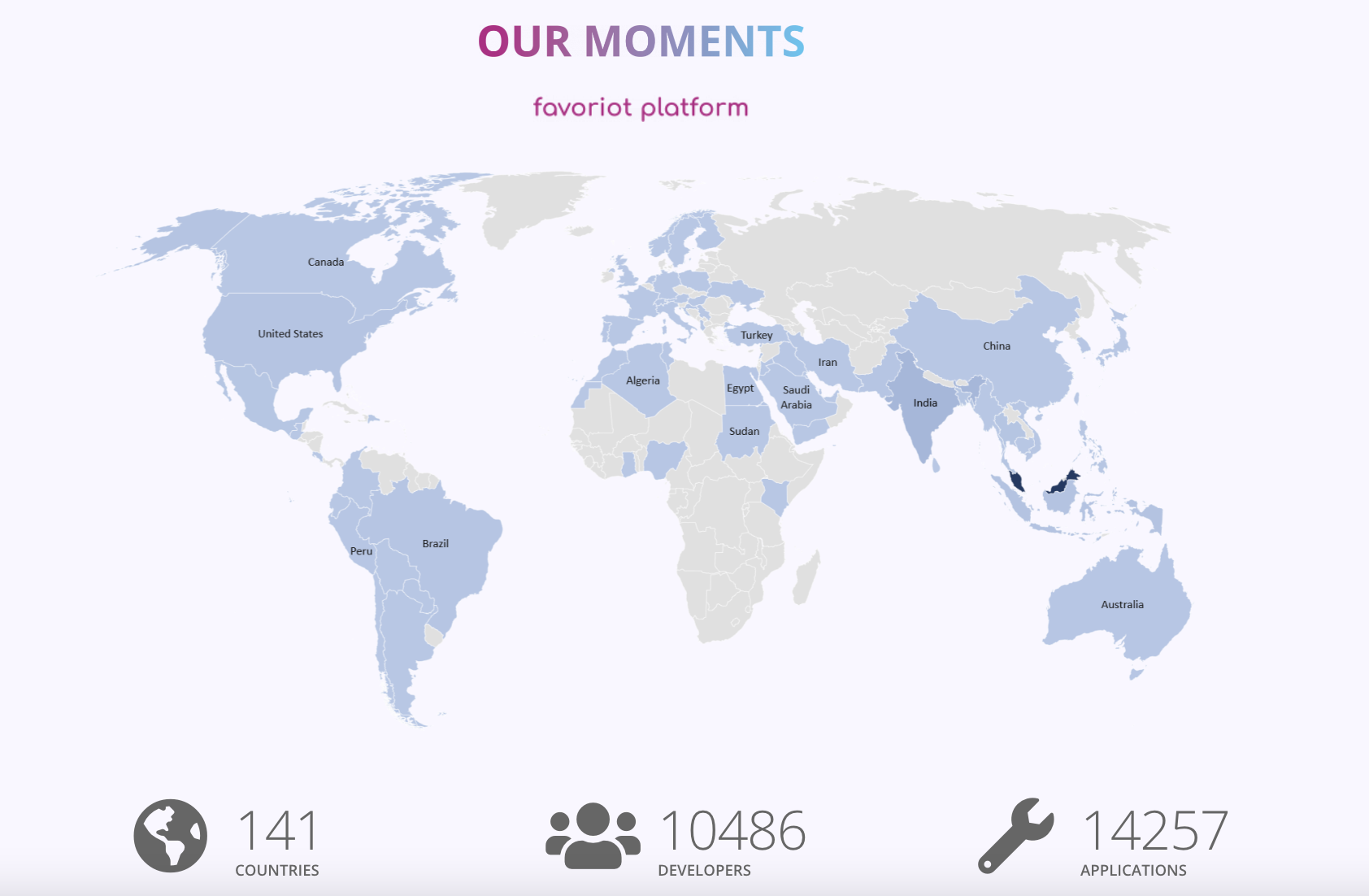
The Favoriot Developer Community has progressed from a modest starting point to a structured, increasingly international ecosystem of developers, institutions, and industry participants. Its growth reflects not only rising interest in IoT development, but also a broader shift toward practical, application-driven adoption of connected technologies.
This article provides an analytical view of the community’s evolution, its geographic distribution, the types of organisations involved, and the application domains that are shaping its development trajectory.
Evolution of the Community
In its early phase, the community was primarily driven by exploratory use. Developers, students, and early adopters engaged with the platform to understand device connectivity, data ingestion, and basic visualisation.
Over time, this exploratory activity matured into more structured development efforts. The focus gradually shifted from proof-of-concept experimentation toward building functional systems with defined use cases. This transition marks an important milestone, indicating that the platform is no longer used solely for learning but increasingly for solution development.
The current state of the community reflects a layered progression:
- Initial onboarding through experimentation
- Skill development through iterative prototyping
- Advancement toward applied, real-world use cases
This progression is typical of ecosystems that support both education and industry adoption.
Geographic Distribution
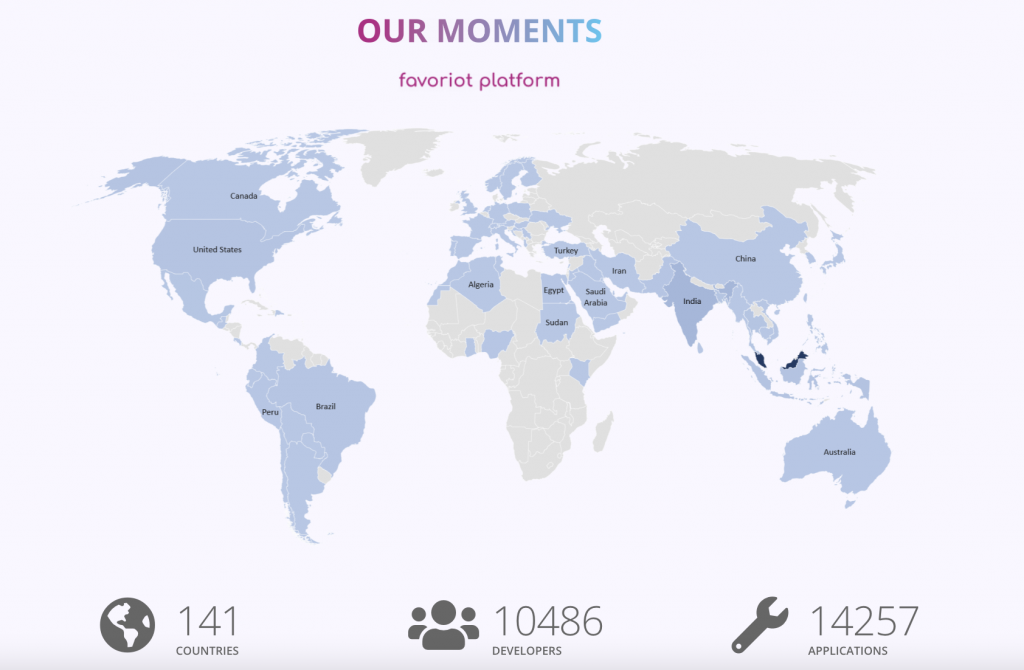
The Favoriot Developer Community demonstrates a strong regional foundation with growing international participation.
Top 5 countries by user concentration:
- Malaysia
- India
- Indonesia
- Philippines
- Thailand
Malaysia remains the primary contributor, supported by sustained engagement with universities, training initiatives, and local industry collaborations. This provides a stable base for continued growth.
The presence of India, Indonesia, and the Philippines highlights strong engagement from emerging digital economies where IoT adoption is accelerating. Thailand’s inclusion reflects regional expansion within Southeast Asia.
Overall, the geographic distribution suggests that the platform resonates particularly well in markets with a combination of technical talent, growing digital infrastructure, and demand for cost-effective IoT solutions.
Organisational Demographics
The community is characterised by a diverse mix of participants across different organisational types. This diversity is a key strength, as it enables knowledge exchange across academic, technical, and operational domains.
Top 5 organisation types:
- Universities and academic institutions
- Students and individual developers
- System integrators and solution providers
- Corporate and industrial organisations
- Government and public sector entities
Academic institutions and students form the largest segment, reflecting the platform’s accessibility and suitability for learning environments. This segment plays a critical role in talent development and early-stage experimentation.
System integrators and solution providers represent the bridge between prototypes and deployment. Their involvement signals increasing interest in commercial applications and integration into existing systems.
Corporate and industrial users indicate growing recognition of IoT as a tool for operational improvement. Meanwhile, participation from government agencies suggests alignment with broader initiatives in smart cities, infrastructure monitoring, and public service optimisation.
Application Landscape
An analysis of projects developed within the community reveals several dominant application categories. These categories reflect both global trends and region-specific priorities.
1. Smart Environment Monitoring
Applications include weather monitoring, air quality tracking, and flood detection systems. These use cases are often foundational and serve as entry points for developers.
2. Smart Mobility and Tracking
Projects focus on vehicle tracking, fleet management, and logistics monitoring. These applications address operational visibility and asset management challenges.
3. Energy and Utility Monitoring
This category includes energy consumption tracking, water monitoring, and leakage detection. These solutions are closely linked to cost management and resource optimisation.
4. Smart Agriculture
Applications involve soil monitoring, irrigation control, and greenhouse management. These projects are particularly relevant in regions where agriculture remains a key economic sector.
5. Industrial Monitoring and Predictive Systems
More advanced implementations include machine condition monitoring, vibration analysis, and predictive maintenance. These use cases demonstrate a shift toward higher-value, data-driven decision support systems.
Key Observations
Several insights emerge from the analysis of the Favoriot Developer Community:
- Strong academic foundation
The high participation from universities and students ensures a continuous pipeline of skilled developers and new ideas. - Gradual transition to industry use
The presence of system integrators and corporate users indicates movement toward commercial deployment. - Regional strength with global potential
While the community is anchored in Malaysia and Southeast Asia, its reach is expanding into other regions with similar adoption needs. - Application-driven engagement
Developers are not only learning the technology but applying it to solve practical problems across multiple sectors.
The Path Forward
The next phase of growth will depend on the community’s ability to move beyond experimentation toward scalable deployment.
The critical success factors include:
- Converting prototypes into deployable solutions
- Strengthening collaboration between academia and industry
- Supporting system integrators in delivering production-grade implementations
- Expanding into new geographic markets through partnerships
This transition will define the community’s long-term value and its contribution to the broader IoT ecosystem.
Conclusion and Call to Action
The Favoriot Developer Community has established a strong foundation built on learning, experimentation, and gradual progression toward real-world applications.
The opportunity now lies in accelerating this momentum.
For existing members, the focus should shift toward building solutions that address real operational challenges and can be deployed at scale.
For new participants, the barrier to entry remains low. The platform provides a practical environment to begin developing IoT applications and to progress from basic connectivity to meaningful outcomes.
Organisations, developers, and institutions interested in advancing their IoT capabilities are encouraged to engage with the Favoriot Developer Community and help shape the next phase of connected solutions.
Register Favoriot for FREE and give it a try!