
Favoriot Use Case : Smart Environmental Museum Monitoring
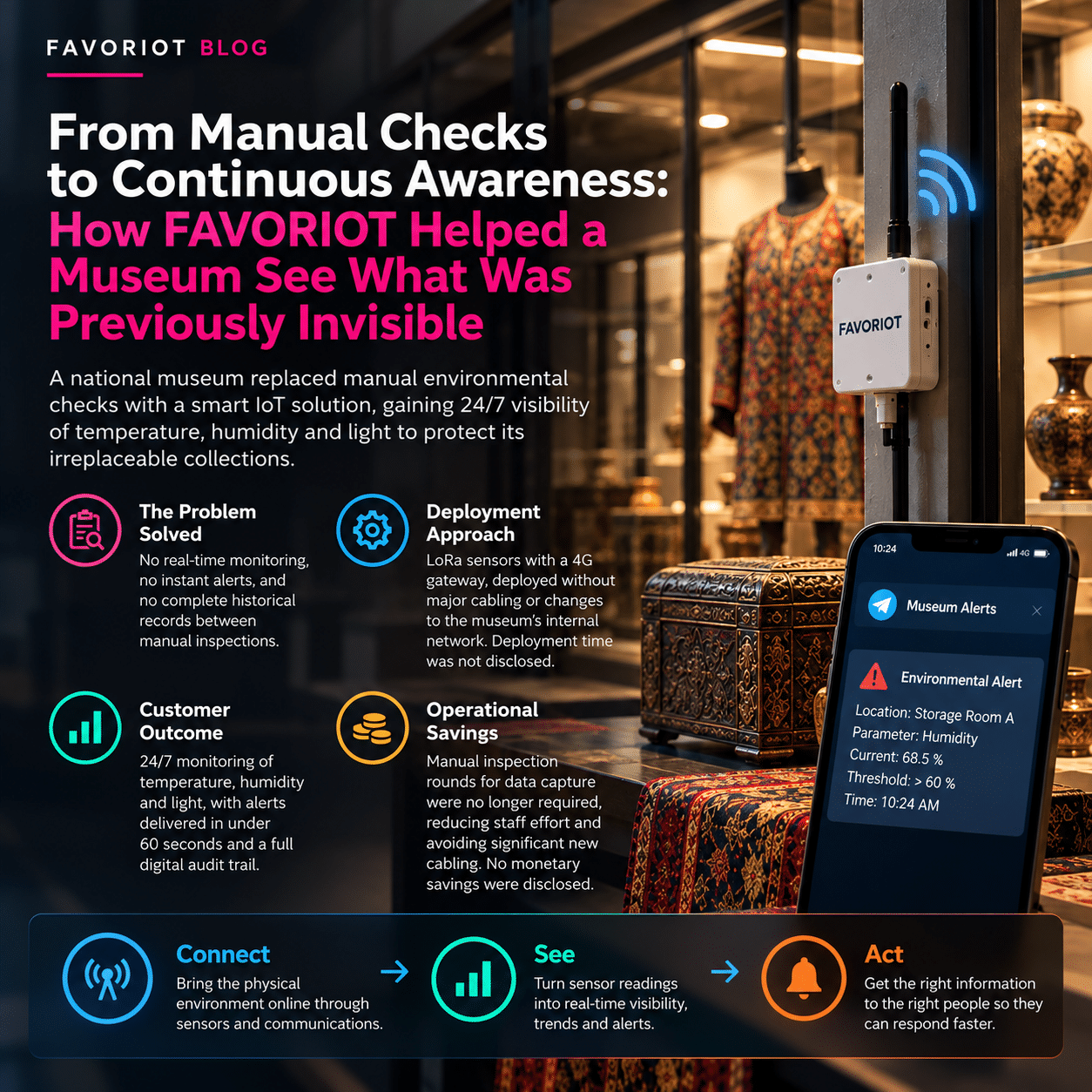
October 1st, 2026 Posted by favoriotadmin BLOG, HOW-TO, Internet of Things, IOT PLATFORM, Operational Blindness 0 thoughts on “Favoriot Use Case : Smart Environmental Museum Monitoring”From Manual Checks to Continuous Awareness: How FAVORIOT Helped a Museum See What Was Previously Invisible
Protecting a museum collection involves more than physical security. Environmental conditions inside storage repositories can also affect the long-term preservation of sensitive objects, particularly when temperature, humidity or light remain outside appropriate ranges.
For one national museum, these conditions were monitored through scheduled manual inspections. Staff checked instruments and recorded readings, but each observation represented only one moment in time. Conditions could change between inspections without anyone immediately knowing.
The challenge was clear: the museum needed to move from periodic monitoring to continuous operational visibility.
The Problem We Needed to Solve
The museum did not simply need more environmental measurements. It needed to know what was happening between manual inspections.
The existing process could not provide continuous awareness or automatically notify personnel when readings crossed configured thresholds. Historical information was also less complete because environmental data depended on scheduled observations.
The objective was to create a system capable of monitoring conditions continuously, recording what happened and notifying the appropriate personnel when intervention might be required.
Connect: Bring the Physical Environment Online
The deployment focused on three parameters: temperature, relative humidity and light. LoRa sensors collected environmental readings from storage areas and transmitted them wirelessly to a gateway.
The gateway then used a 4G connection to send the information to the FAVORIOT Platform. This approach reduced the need for significant new cabling and allowed the initial deployment to operate independently of the museum’s internal network.
The exact deployment duration was not documented in the case study, so we do not make an unsupported claim about the number of days required. The architecture was designed to keep deployment focused and reduce unnecessary dependencies on existing infrastructure.
See: Replace Snapshots With 24/7 Visibility
Once connected, environmental information became continuously available through the FAVORIOT Platform. Personnel could see current readings, review historical trends and understand how conditions changed over time.
More importantly, the platform continuously evaluated incoming readings against configured thresholds. Instead of waiting for the next inspection to discover an abnormal condition, the system could identify the event as it happened.
The result was 24/7 monitoring of temperature, humidity and light, supported by a digital, time-stamped history of environmental readings and alert events.
Act: Turn Visibility Into Response
When readings exceeded configured thresholds, alerts could be sent automatically through Telegram to designated personnel. Notifications provided information such as the affected storage area, environmental parameter, current reading and timestamp.
Alert delivery could occur in less than 60 seconds. This meant personnel no longer had to depend solely on the next scheduled inspection to discover that something had changed.
This is where operational visibility becomes useful. The purpose of monitoring is not simply to display information. It is to help someone recognise that attention is required and respond sooner.
What Did the Customer Gain and Where Were the Savings?
One of the clearest operational improvements was the removal of manual inspection rounds specifically for environmental data capture. Readings were collected automatically, allowing staff to spend less time gathering routine information.
The project also reduced infrastructure requirements through wireless sensing and cellular communications. The measurable benefit was reduced manual data-collection effort combined with continuous monitoring and faster awareness of abnormal conditions.
For an organisation protecting irreplaceable assets, another potential benefit is avoiding the consequences of discovering a problem too late. That value may be difficult to express as a simple cost-saving percentage, but it is central to the purpose of the system.
Connect • See • Act™
The entire project can be understood through FAVORIOT’s Connect • See • Act™ framework.
Connect brings the physical environment into the platform through sensors and communications. See gives the customer continuous visibility into conditions, trends and abnormalities. Act turns that visibility into timely notification so people can respond when something needs attention.
This is the outcome we want from an Operational Visibility Platform. The goal is not simply to connect another sensor or create another dashboard. It is to reduce the time between something happening, someone knowing about it, and someone being able to act.