Posts in HOW-TO

Favoriot ESG

Why IoT Has Become the Backbone of ESG Monitoring

February 10th, 2026 Posted by BLOG, HOW-TO, Internet of Things, IOT PLATFORM, PRODUCT 0 thoughts on “Why IoT Has Become the Backbone of ESG Monitoring”

ESG is no longer driven by intention statements or annual summaries. Today, organisations are expected to show evidence. Regulators want proof. Investors want consistency. Customers want transparency.

At the centre of this shift sits one critical enabler: IoT.

IoT transforms ESG reporting from a compliance obligation into an operational capability by capturing real-world data directly from assets, facilities, and environments. Without this layer of measurement, ESG metrics are often based on assumptions rather than facts.

ESG Needs Measured Reality, Not Estimates

Many organisations still depend on:

  • Periodic meter readings
  • Manual logs
  • Spreadsheets are updated once a quarter or once a year

These methods struggle to survive audits and increasingly fall short of modern disclosure expectations. ESG today demands data that is:

  • Continuous
  • Verifiable
  • Traceable to source

IoT fills this gap by collecting information automatically, consistently, and in real time.

How IoT Supports Each ESG Pillar

Environmental: Where IoT Plays the Largest Role

Environmental indicators are the most measurable and the most scrutinised. IoT enables direct monitoring of key environmental metrics such as:

  • Energy usage
    • Electricity consumption by machine, line, or facility
    • Peak demand and load behaviour
    • Renewable energy contribution
  • Emissions and air quality
    • CO₂ concentration
    • Particulate matter
    • Indoor air quality in controlled spaces
  • Water consumption
    • Inflow and discharge volumes
    • Leak detection
    • Process water usage
  • Waste tracking
    • Waste volumes
    • Recycling rates
    • Hazardous material handling

These measurements underpin carbon accounting, energy intensity reporting, and environmental risk management.

Social: Protecting People Through Data

IoT contributes to the Social pillar by improving visibility into workplace conditions, especially in operational environments.

Typical applications include:

  • Monitoring temperature and humidity on production floors
  • Detecting gas leaks or unsafe exposure levels
  • Identifying equipment conditions that could lead to accidents

In sectors such as manufacturing, construction, and energy, these indicators are closely linked to legal and ethical responsibilities.

Governance: Building Trust Through Data Integrity

Governance is not measured by sensors, but it depends on the quality of the data behind decisions.

IoT strengthens governance by:

  • Reducing manual intervention in data collection
  • Creating time-stamped, tamper-resistant records
  • Supporting audit readiness with clear data trails

When ESG figures are backed by operational data, governance moves from declarations to defensible accountability.

What ESG Monitoring Is Commonly Expected

While ESG rules vary by country and industry, several monitoring areas are widely treated as baseline requirements.

AreaESG PillarWhy It Matters
Energy consumptionEnvironmentalCarbon and efficiency metrics
Emissions dataEnvironmentalClimate-related disclosures
Water usageEnvironmentalResource risk and compliance
Pollution indicatorsEnvironmentalRegulatory and community impact
Worker safety metricsSocialDuty of care
Data traceabilityGovernanceAudit credibility

Organisations lacking reliable data in these areas often face delays, higher audit costs, and increased scrutiny.

Example: ESG Monitoring in a Manufacturing Factory

Consider a medium-sized factory operating multiple production lines.

Environmental Monitoring

  • Smart meters track electricity usage at:
    • Incoming power supply
    • Individual production lines
    • High-energy equipment such as compressors
  • Water flow sensors monitor:
    • Process water consumption
    • Cooling systems
    • Discharge points
  • Air quality sensors measure:
    • Indoor CO₂ levels
    • Particulate concentration
    • Ventilation effectiveness

This setup allows the factory to calculate energy intensity per unit produced, detect abnormal consumption early, and support environmental reporting with confidence.

Social Monitoring

  • Temperature and humidity sensors ensure safe working conditions
  • Gas detectors provide early alerts before exposure becomes dangerous
  • Equipment monitoring helps reduce accidents caused by malfunctioning machinery

Threshold breaches trigger alerts, enabling prompt corrective action.

Governance Enablement

All collected data is:

  • Logged automatically
  • Stored securely
  • Visualised through dashboards
  • Exportable for audits and ESG disclosures

This gives management visibility not just into outcomes, but also into actions taken when issues arise.

Turning IoT Data into ESG Insight

Raw sensor data alone is not enough. It must be structured, contextualised, and aligned with ESG indicators.

This is where an IoT platform becomes essential. Platforms like Favoriot help organisations manage data from multiple sensors, locations, and systems while presenting ESG-relevant insights through dashboards, alerts, and historical views. This makes ESG monitoring scalable across factories, buildings, and regions without adding operational complexity.

Closing Thoughts

ESG expectations continue to rise, and tolerance for estimates is shrinking.

IoT provides the foundation for:

  • Measurable environmental performance
  • Safer workplaces
  • Stronger governance backed by evidence

For organisations serious about ESG, monitoring is no longer optional. It is the starting point for trust, accountability, and long-term credibility.


Smart Cities and Favoriot

Widely Adopted Smart City Applications

February 9th, 2026 Posted by BLOG, HOW-TO, Internet of Things, IOT PLATFORM 0 thoughts on “Widely Adopted Smart City Applications”

Priorities, Implementation Challenges, and Practical Responses

Executive Summary

Cities worldwide are turning to smart city technologies to cope with rising urban demands, ageing infrastructure, and tighter operational budgets. While smart city visions often span many domains, real-world deployments show a consistent starting point. Most cities begin with a small set of applications that solve visible, operational problems and can be justified through clear outcomes.

This paper examines the three smart city application areas most commonly deployed globally and explains not only why they are prioritised, but also the key challenges cities face during implementation and practical approaches to overcoming them.

1. Smart Mobility and Traffic Management

Purpose and scope

Smart mobility systems focus on improving traffic flow, reducing congestion, and enhancing safety across urban road networks. Typical deployments include adaptive traffic signals, traffic flow monitoring, smart parking systems, and real-time visibility into public transport.

These systems rely on data collected from sensors, cameras, and transport assets to support operational decisions at both junction and network levels.

Why cities prioritise mobility

Traffic congestion directly affects productivity, fuel consumption, air quality, and emergency response. It is also highly visible to residents, making it a frequent political and operational concern.

Mobility projects are often prioritised because they deliver measurable results quickly, such as reduced waiting times or improved junction throughput. Existing road infrastructure also provides clear and accessible locations for sensor deployment.

Key challenges

Cities often encounter several issues when deploying smart mobility solutions:

  • Fragmented systems where traffic, parking, and public transport operate independently
  • Over-reliance on visual dashboards without linking insights to field operations
  • Limited data quality due to inconsistent sensor placement or calibration
  • Difficulty scaling pilot projects beyond selected corridors

Practical approaches

To address these challenges, cities should:

  • Begin with high-impact routes or congestion hotspots rather than attempting city-wide coverage
  • Link traffic alerts and insights directly to traffic control rooms and enforcement teams
  • Standardise data collection methods across sensors and systems
  • Design solutions with expansion in mind, allowing additional intersections and corridors to be added incrementally

2. Smart Energy and Utilities Management

Purpose and scope

Smart utility systems aim to improve visibility and control over electricity, water, and public infrastructure consumption. Typical applications include smart metering, street lighting control, water leak detection, and energy monitoring in public buildings.

These systems help cities understand where resources are consumed, wasted, or underperforming.

Why cities prioritise utilities

Utilities represent a large and recurring operational expense for municipalities. Energy losses, water leakage, and inefficient lighting often go unnoticed without continuous monitoring.

Smart utility projects are also closely linked to sustainability targets, climate commitments, and national energy reporting requirements, thereby strengthening their business case.

Key challenges

Common challenges in utilities deployments include:

  • Legacy infrastructure is not designed for digital monitoring
  • Data overload without clear thresholds or response actions
  • Limited coordination between utilities, facilities, and maintenance teams
  • Difficulty demonstrating savings without a clear baseline

Practical approaches

Cities can reduce these risks by:

  • Starting with assets that have known issues or high operating costs
  • Establishing baseline consumption measurements before optimisation
  • Defining clear alert thresholds and maintenance response workflows
  • Integrating operational monitoring with long-term reporting for finance and sustainability teams

3. Public Safety and Urban Surveillance

Purpose and scope

Public safety systems enhance situational awareness and support faster, better-coordinated responses to incidents. Typical deployments include CCTV networks, incident detection systems, emergency response coordination tools, and integrated command centres.

These systems are designed to support prevention, early detection, and response.

Why cities prioritise safety

Safety is a core responsibility of city authorities. Technologies that reduce response times and improve coordination across agencies are often treated as essential infrastructure.

Public safety projects also tend to receive public support when benefits such as faster emergency response and improved accountability are clearly demonstrated.

Key challenges

Public safety deployments often face:

  • Fragmentation between police, fire, medical, and city operations
  • High volumes of data require constant human monitoring
  • Privacy concerns and unclear governance structures
  • Technology deployments without agreed response procedures

Practical approaches

Effective public safety systems require:

  • Clearly defined response protocols before system activation
  • Integration across agencies rather than isolated deployments
  • Governance policies covering access control, data retention, and oversight
  • A shift from continuous monitoring to event-driven alerts that prompt action

Cross-Cutting Challenges Across Smart City Applications

Across all three application domains, cities commonly face shared issues:

  • Siloed systems managed by different departments or vendors
  • Difficulty scaling pilots into operational city-wide systems
  • Limited reuse of data across departments
  • Dependence on dashboards without operational integration

These challenges often stem from technology-first deployments that lack a unified operational strategy.

Platform Strategy as an Enabler

A shared IoT platform approach helps cities manage multiple applications within a consistent operational framework. This enables standardised data ingestion, common alerting rules, and shared access controls across departments.

Platforms such as FAVORIOT support multi-domain deployments by enabling cities to manage mobility, utilities, and safety use cases within a single environment while retaining the flexibility to grow and adapt over time.

Closing Perspective

Smart mobility, smart utilities, and public safety systems are widely adopted because they solve real problems and deliver measurable outcomes. Their success depends not only on technology, but on careful planning, phased deployment, and strong operational alignment.

Cities that address implementation challenges early and adopt a scalable platform strategy are better positioned to move from isolated projects toward coordinated, data-informed urban management.

man standing beside people sitting beside table with laptops

FAVORIOT IoT Certification and IoT Lab for Universities – Bridging Academia and Industry

October 1st, 2025 Posted by BLOG, HOW-TO, Internet of Things, IOT PLATFORM, Training 0 thoughts on “FAVORIOT IoT Certification and IoT Lab for Universities – Bridging Academia and Industry”

1. Introduction

The future workforce needs more than theory; it requires hands-on, industry-driven skills. Universities worldwide are racing to prepare students for the Fourth Industrial Revolution (IR 4.0), where the Internet of Things (IoT) plays a central role. However, many institutions struggle with two challenges:

  1. Lack of industry-aligned certifications that make graduates more employable.
  2. Insufficient access to real-world IoT systems and labs that allow students to build, test, and deploy solutions.

FAVORIOT bridges this gap through IoT Certifications and the IoT Lab Package, ensuring that students graduate with both academic credentials and industry-recognised certifications.

2. IoT Certifications with Universities

FAVORIOT collaborates with higher education institutions to integrate IoT certifications into their programs. The entry requirement is that lecturers must first be certified as FAVORIOT Certified Trainers by passing the FAVORIOT Professional Certificate Exam.

Once certified, lecturers can offer students two methods to earn industry certification:

  1. Conduct Similar Training for Students
    • Students undergo the same structured training.
    • Upon completion, they can earn either:
      • Completion Certificate, or
      • A Professional Certificate (via exam), which is optional but offers higher industry recognition.
  2. Embed Certification into the IoT Syllabus
    • Certification modules (theory + hands-on lab sessions) are integrated directly into the university’s IoT courses.
    • Students earn credit hours and have the option to pursue industry certification.

This dual pathway ensures flexibility, allowing universities to either treat certification as a standalone program or seamlessly embed it into existing curricula.

3. The FAVORIOT IoT Lab Package

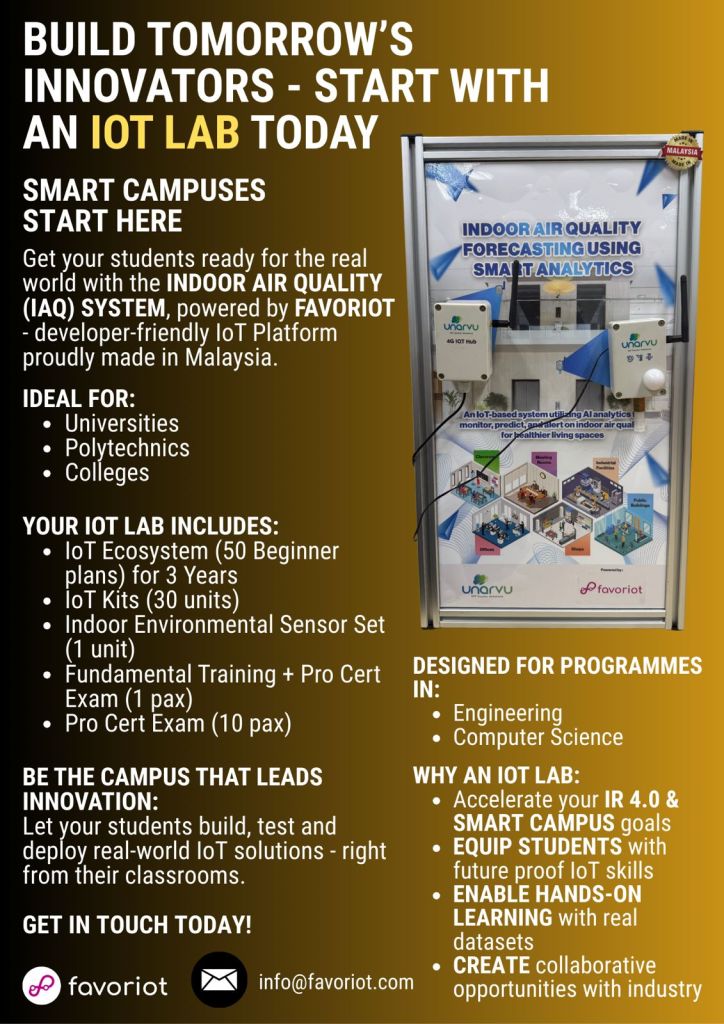
To simplify the certification rollout, FAVORIOT offers a turnkey IoT Lab Package, designed to provide institutions with everything needed to deliver hands-on IoT education.

Components of the IoT Lab:

  • IoT Ecosystem (50 Beginner Plans for 3 Years)
    • A cloud-based platform for managing IoT devices, data, and applications.
    • Multiple student accounts can be created for coursework, lab experiments, and final year projects.
    • Accounts are recyclable and reusable within the contract period—ensuring cost efficiency while supporting new batches of students each semester.
  • IoT Kits (30 Units)
    • Ready-to-use development kits with sensors and connectivity modules.
    • Enable students to prototype IoT solutions rapidly.
  • Indoor Environmental Sensor Set (1 Unit)
    • Smart Environmental System that monitors real-world conditions such as air quality.
    • Demonstrates how IoT is applied in commercial settings (e.g., smart buildings, healthcare, and smart campuses).
  • Training and Certifications
    • Fundamental IoT Training + Pro Cert Exam (1 pax) – equips one faculty member with mastery of the FAVORIOT platform.
    • Professional Certificate Exams (10 pax) – bundled for students, ensuring the first cohort can be industry certified.

4. Value Proposition to Universities

By adopting the FAVORIOT IoT Certification and Lab, universities can:

  • Differentiate Their Programs
    • Offering IoT certification adds value beyond the degree. Graduates gain both academic qualifications and industry credentials.
  • Enhance the Employability of Students
    • Students graduate with skills recognised by industry, improving their chances of securing jobs in engineering, computer science, and technology sectors.
  • Support Final Year Projects (FYP)
    • Students can use the IoT ecosystem to manage data, build dashboards, and integrate hardware for their capstone projects.
  • Future-Proof Curriculum
    • Embedding real-world IoT systems into labs keeps academic programs aligned with industry needs.
  • Accelerate IR 4.0 and Smart Campus Goals
    • Universities demonstrate leadership by building smart campuses that embody the principles they teach.

5. Conclusion

FAVORIOT empowers universities to transform their IoT education strategy. By combining lecturer certificationstudent certification pathways, and the IoT Lab package, institutions can deliver industry-relevant, hands-on, and certifiable IoT skills to their students.

This model ensures that students graduate not only with theoretical knowledge but also with the confidence, tools, and certifications necessary to thrive in the rapidly growing IoT job market.

Next Step for Universities:
Adopt the FAVORIOT IoT Lab and Certification program to position your campus as a leader in innovation, producing graduates ready to build and lead in the IoT economy.

Copyright © 2026 All rights reserved