
Posts tagged "IoT"

Favoriot ESG

Why IoT Has Become the Backbone of ESG Monitoring

February 10th, 2026 Posted by BLOG, HOW-TO, Internet of Things, IOT PLATFORM, PRODUCT 0 thoughts on “Why IoT Has Become the Backbone of ESG Monitoring”

ESG is no longer driven by intention statements or annual summaries. Today, organisations are expected to show evidence. Regulators want proof. Investors want consistency. Customers want transparency.

At the centre of this shift sits one critical enabler: IoT.

IoT transforms ESG reporting from a compliance obligation into an operational capability by capturing real-world data directly from assets, facilities, and environments. Without this layer of measurement, ESG metrics are often based on assumptions rather than facts.

ESG Needs Measured Reality, Not Estimates

Many organisations still depend on:

  • Periodic meter readings
  • Manual logs
  • Spreadsheets are updated once a quarter or once a year

These methods struggle to survive audits and increasingly fall short of modern disclosure expectations. ESG today demands data that is:

  • Continuous
  • Verifiable
  • Traceable to source

IoT fills this gap by collecting information automatically, consistently, and in real time.

How IoT Supports Each ESG Pillar

Environmental: Where IoT Plays the Largest Role

Environmental indicators are the most measurable and the most scrutinised. IoT enables direct monitoring of key environmental metrics such as:

  • Energy usage
    • Electricity consumption by machine, line, or facility
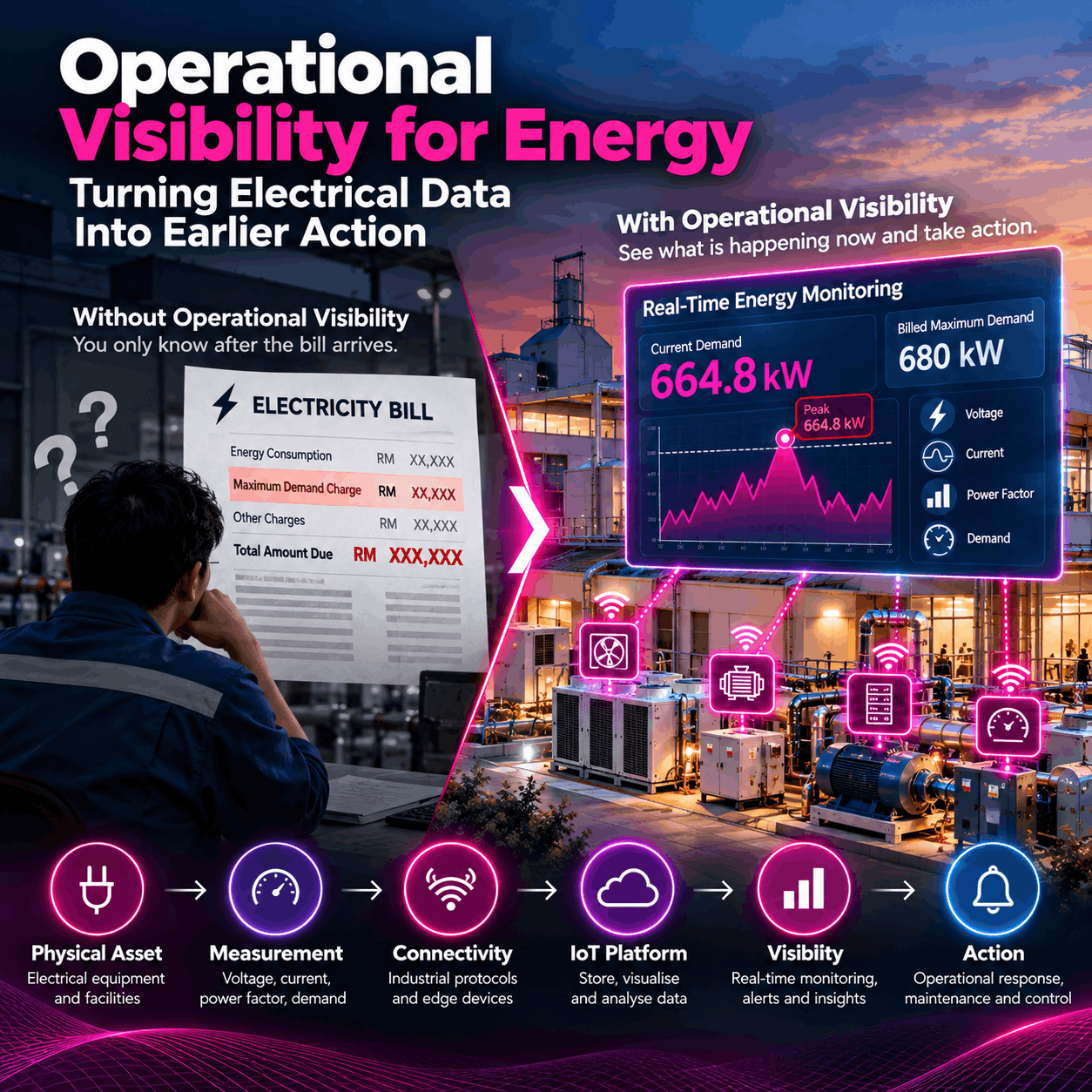
    • Peak demand and load behaviour
    • Renewable energy contribution
  • Emissions and air quality
    • CO₂ concentration
    • Particulate matter
    • Indoor air quality in controlled spaces
  • Water consumption
    • Inflow and discharge volumes
    • Leak detection
    • Process water usage
  • Waste tracking
    • Waste volumes
    • Recycling rates
    • Hazardous material handling

These measurements underpin carbon accounting, energy intensity reporting, and environmental risk management.

Social: Protecting People Through Data

IoT contributes to the Social pillar by improving visibility into workplace conditions, especially in operational environments.

Typical applications include:

  • Monitoring temperature and humidity on production floors
  • Detecting gas leaks or unsafe exposure levels
  • Identifying equipment conditions that could lead to accidents

In sectors such as manufacturing, construction, and energy, these indicators are closely linked to legal and ethical responsibilities.

Governance: Building Trust Through Data Integrity

Governance is not measured by sensors, but it depends on the quality of the data behind decisions.

IoT strengthens governance by:

  • Reducing manual intervention in data collection
  • Creating time-stamped, tamper-resistant records
  • Supporting audit readiness with clear data trails

When ESG figures are backed by operational data, governance moves from declarations to defensible accountability.

What ESG Monitoring Is Commonly Expected

While ESG rules vary by country and industry, several monitoring areas are widely treated as baseline requirements.

AreaESG PillarWhy It Matters
Energy consumptionEnvironmentalCarbon and efficiency metrics
Emissions dataEnvironmentalClimate-related disclosures
Water usageEnvironmentalResource risk and compliance
Pollution indicatorsEnvironmentalRegulatory and community impact
Worker safety metricsSocialDuty of care
Data traceabilityGovernanceAudit credibility

Organisations lacking reliable data in these areas often face delays, higher audit costs, and increased scrutiny.

Example: ESG Monitoring in a Manufacturing Factory

Consider a medium-sized factory operating multiple production lines.

Environmental Monitoring

  • Smart meters track electricity usage at:
    • Incoming power supply
    • Individual production lines
    • High-energy equipment such as compressors
  • Water flow sensors monitor:
    • Process water consumption
    • Cooling systems
    • Discharge points
  • Air quality sensors measure:
    • Indoor CO₂ levels
    • Particulate concentration
    • Ventilation effectiveness

This setup allows the factory to calculate energy intensity per unit produced, detect abnormal consumption early, and support environmental reporting with confidence.

Social Monitoring

  • Temperature and humidity sensors ensure safe working conditions
  • Gas detectors provide early alerts before exposure becomes dangerous
  • Equipment monitoring helps reduce accidents caused by malfunctioning machinery

Threshold breaches trigger alerts, enabling prompt corrective action.

Governance Enablement

All collected data is:

  • Logged automatically
  • Stored securely
  • Visualised through dashboards
  • Exportable for audits and ESG disclosures

This gives management visibility not just into outcomes, but also into actions taken when issues arise.

Turning IoT Data into ESG Insight

Raw sensor data alone is not enough. It must be structured, contextualised, and aligned with ESG indicators.

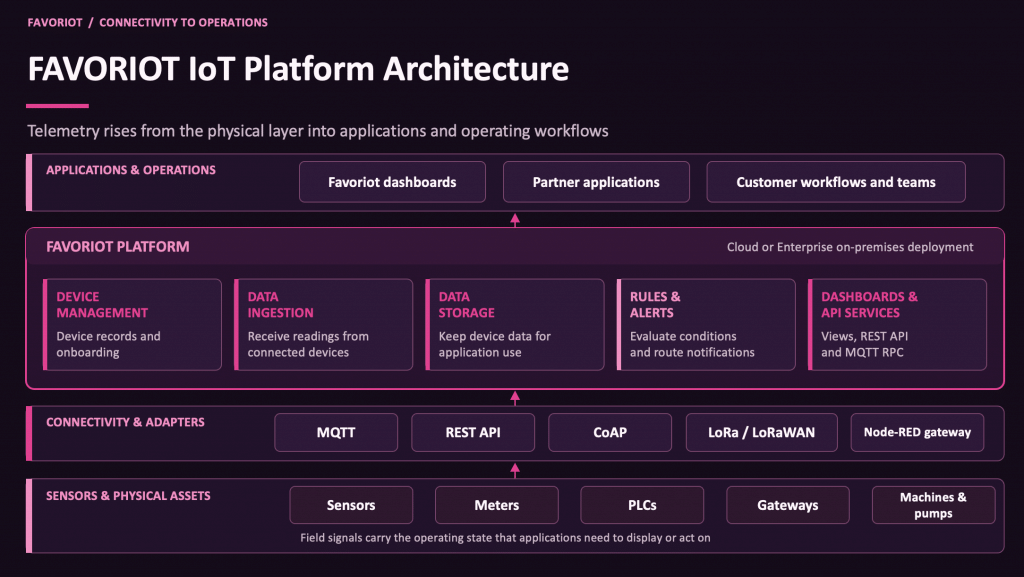
This is where an IoT platform becomes essential. Platforms like Favoriot help organisations manage data from multiple sensors, locations, and systems while presenting ESG-relevant insights through dashboards, alerts, and historical views. This makes ESG monitoring scalable across factories, buildings, and regions without adding operational complexity.

Closing Thoughts

ESG expectations continue to rise, and tolerance for estimates is shrinking.

IoT provides the foundation for:

  • Measurable environmental performance
  • Safer workplaces
  • Stronger governance backed by evidence

For organisations serious about ESG, monitoring is no longer optional. It is the starting point for trust, accountability, and long-term credibility.

Favoriot Launches Lite Plan to Support Students, Beginners, and Early IoT Builders

Favoriot Launches Lite Plan to Support Students, Beginners, and Early IoT Builders

January 25th, 2026 Posted by BLOG, CAMPAIGN, Internet of Things, IOT PLATFORM, NEWS 0 thoughts on “Favoriot Launches Lite Plan to Support Students, Beginners, and Early IoT Builders”

FOR IMMEDIATE RELEASE

Kuala Lumpur, 23 January 2026
Favoriot today announced the launch of its new Lite Plan, a lower-entry subscription designed to help students, educators, beginners, startup founders, and developers begin their IoT journey using a real, production-grade platform.

The Lite Plan addresses a growing need for a simple, affordable way to connect devices, view data, and understand IoT workflows without the complexity often found in larger, enterprise-focused plans. Users on the Lite Plan gain access to the same core Favoriot platform used by commercial and government deployments, scaled to suit learning, experimentation, and early validation.

The Lite Plan is about removing friction at the starting line,” said Dr. Mazlan Abbas, Co-Founder and CEO of Favoriot. “Many users want to learn or test ideas with real devices and real data, but do not need advanced features yet. This plan gives them a proper foundation without overcommitment.”

Designed for Specific User Segments

The Lite Plan is best suited for:

  • Students and educators working on coursework, labs, or final-year projects who need hands-on experience with an industry platform
  • IoT beginners using devices such as ESP32 or Arduino and learning basic device-to-cloud data flows
  • Startup teams and founders building proofs of concept or early prototypes
  • Developers and technologists evaluating IoT platforms before selecting a long-term solution

Clear Progression Across Plans

Favoriot positions the Lite Plan as a starting point within its broader subscription structure:

  • Lite Plan: Entry-level access for learning, testing, and early exploration
  • Beginner Plan: Expanded usage for wider testing and multiple devices
  • Developer Plan: Application development, integrations, and pilot deployments
  • Professional and Enterprise Plans: Full-scale production, security controls, and operational workflows

Users can upgrade plans as their projects grow, with continuity across devices and data.

Availability

The Favoriot Lite Plan is available immediately. Full pricing and plan details can be found at:
https://www.favoriot.com/iotplatform/pricing/

About Favoriot
Favoriot is a Malaysia-based IoT and AIoT platform provider supporting smart city, agriculture, manufacturing, education, and enterprise use cases. The platform enables secure device management, real-time data ingestion, analytics, and automation for organisations at every stage of adoption.

Media Contact
Favoriot Communications Team
https://www.favoriot.com

[Tutorial] : Automated Quality Inspection System Using AI & FAVORIOT

April 6th, 2025 Posted by BLOG, HOW-TO, Internet of Things, IOT PLATFORM, TIPS 0 thoughts on “[Tutorial] : Automated Quality Inspection System Using AI & FAVORIOT”

This guide will show you how to build an AI-powered quality inspection system using a camera and send inspection results to the FAVORIOT IoT platform in real time.


🔧 Step 1: What You Need

Hardware:

  • Raspberry Pi (or any computer with a camera)
  • Camera (USB or Pi Camera)
  • Internet connection

Software:

  • Python 3
  • Libraries: opencv-python, tensorflow, numpy, requests

🛠️ Step 2: Install the Required Software

Open Terminal and run:

sudo apt update && sudo apt upgrade -y
sudo apt install python3-pip -y
pip3 install opencv-python numpy requests tensorflow

🧠 Step 3: Train an AI Model to Detect Defects

Create a folder called dataset_defects with 2 subfolders: defect and normal.

Now, use this Python code to train the model:

import tensorflow as tf
from tensorflow.keras.preprocessing.image import ImageDataGenerator

dataset_path = "dataset_defects"
batch_size = 32
img_size = (224, 224)

datagen = ImageDataGenerator(rescale=1./255, validation_split=0.2)

train_data = datagen.flow_from_directory(
    dataset_path,
    target_size=img_size,
    batch_size=batch_size,
    class_mode="binary",
    subset="training"
)

val_data = datagen.flow_from_directory(
    dataset_path,
    target_size=img_size,
    batch_size=batch_size,
    class_mode="binary",
    subset="validation"
)

base_model = tf.keras.applications.MobileNetV2(input_shape=(224, 224, 3), include_top=False, weights="imagenet")
base_model.trainable = False

model = tf.keras.Sequential([
    base_model,
    tf.keras.layers.GlobalAveragePooling2D(),
    tf.keras.layers.Dense(1, activation="sigmoid")
])

model.compile(optimizer="adam", loss="binary_crossentropy", metrics=["accuracy"])
model.fit(train_data, validation_data=val_data, epochs=10)

model.save("defect_detection_model.h5")

🎥 Step 4: Real-Time Defect Detection Using Camera

Once the model is trained and saved, run this script:

import cv2
import numpy as np
import tensorflow as tf

model = tf.keras.models.load_model("defect_detection_model.h5")
cap = cv2.VideoCapture(0)

while True:
    ret, frame = cap.read()
    if not ret:
        break

    img = cv2.resize(frame, (224, 224))
    img = np.expand_dims(img, axis=0) / 255.0
    prediction = model.predict(img)[0][0]

    label = "Defect Detected!" if prediction > 0.5 else "Product OK"
    color = (0, 0, 255) if prediction > 0.5 else (0, 255, 0)

    cv2.putText(frame, label, (50, 50), cv2.FONT_HERSHEY_SIMPLEX, 1, color, 2)
    cv2.imshow("Quality Inspection", frame)

    if cv2.waitKey(1) & 0xFF == ord('q'):
        break

cap.release()
cv2.destroyAllWindows()

🌐 Step 5: Send Defect Results to FAVORIOT

✅ 1. Set Up a Device in FAVORIOT

  1. Log in to Favoriot Platform
  2. Go to Devices → Add Device
  3. Note down your Device Developer ID and API Key

✅ 2. Add Code to Send Data

Below is the function to send results:

import requests
import json

DEVICE_ID = "YOUR_DEVICE_ID"
API_KEY = "YOUR_FAVORIOT_API_KEY"
URL = "https://apiv2.favoriot.com/v2/streams"

def send_data_to_favoriot(status):
    payload = {
        "device_developer_id": DEVICE_ID,
        "data": {
            "status": status
        }
    }

    headers = {
        "Content-Type": "application/json",
        "Apikey": API_KEY
    }

    response = requests.post(URL, data=json.dumps(payload), headers=headers)
    print("Response from Favoriot:", response.json())

✅ 3. Combine with Real-Time Detection

Add this snippet inside your prediction logic:

if prediction > 0.5:
    send_data_to_favoriot("Defect Detected!")
else:
    send_data_to_favoriot("Product OK")

📊 Step 6: View Data on FAVORIOT Dashboard

  • Go to your device on the FAVORIOT Dashboard
  • Click on Streams to view defect data
  • You can also create graphs or alert rules for monitoring

🚀 Bonus Tips

  • Add Telegram Alerts using Telegram Bot API
  • Add Dashboard Charts using Favoriot’s visualization
  • Improve accuracy with better dataset or model tuning

✅ Summary

With this project, you have:

✅ Built a real-time defect detection system
✅ Displayed results on screen
✅ Sent reports to FAVORIOT cloud platform

References

Disclaimer

This article provides a step-by-step guide and only serves as a guideline. The source code may need adjustments to fit the final project design.

Copyright © 2026 All rights reserved