
Posts in BLOG

Favoriot Analytics, ML and AI

From Data to Decisions: How Favoriot Turns Information into Business Advantage

March 27th, 2026 Posted by BLOG, Internet of Things, IOT PLATFORM 0 thoughts on “From Data to Decisions: How Favoriot Turns Information into Business Advantage”

Executive Perspective

Many organisations today are surrounded by data but still struggle to make better decisions.

Sensors are installed. Systems are connected. Dashboards are built.

Yet the key question remains unanswered:

Are decisions improving?

For business leaders, the value of any technology is not in how it works, but in what it enables. Favoriot’s Analytics and Machine Learning capabilities are designed with this exact purpose. They transform raw operational data into clear insights and forward-looking intelligence that support better, faster, and more confident decisions.

This is not about technology. It is about outcomes.

The First Layer: Understanding What Is Happening

At its core, Favoriot Analytics provides visibility.

For many organisations, this is already a major step forward. Without visibility, operations rely heavily on assumptions, manual checks, and delayed reporting.

Favoriot changes this by presenting data in a clear and structured way through dashboards.

For example, a business can easily monitor:

  • Equipment performance across locations
  • Energy consumption patterns over time
  • Environmental conditions such as temperature or humidity
  • Operational trends during peak and off-peak periods

This allows decision-makers to move from reactive to informed.

Instead of asking, “What went wrong?” after an issue occurs, leaders can continuously observe operations as they unfold.

The result is greater control.

Why Visibility Alone Is Not Enough

While dashboards provide clarity, they do not automatically lead to better outcomes.

They answer the question:

What is happening?

But business performance often depends on answering a more important question:

What is likely to happen next?

Relying solely on historical and real-time data still leaves organisations exposed to risks such as equipment failure, operational disruptions, or unexpected cost increases.

This is where many systems fall short.

They inform, but they do not anticipate.

The Next Layer: From Insight to Foresight

Favoriot’s Machine Learning capability addresses this gap.

It analyses historical data patterns and uses them to anticipate future conditions. This allows organisations to shift from reactive management to proactive planning.

In practical terms, this means:

  • Identifying early warning signs before a failure occurs
  • Forecasting future trends such as energy usage or demand
  • Detecting unusual behaviour that may indicate underlying issues

For business leaders, this translates into one key advantage:

Time.

Time to act before problems escalate.
Time to optimise operations before costs increase.
Time to prevent disruptions before they impact customers.

Business Impact Across Key Areas

1. Risk Reduction

In many industries, maintaining conditions within acceptable limits is critical.

For example, cold storage, manufacturing processes, or healthcare environments must comply with strict standards. A small deviation can result in financial loss, regulatory issues, or reputational damage.

With Favoriot:

  • Analytics ensures continuous monitoring of conditions
  • Machine Learning predicts when conditions may move outside acceptable ranges

This allows organisations to intervene early and maintain compliance with required standards.

2. Cost Optimisation

Operational costs are often influenced by patterns that are not immediately visible.

Energy usage, resource consumption, and equipment performance can vary significantly throughout the day or across locations.

Favoriot helps organisations:

  • Identify inefficiencies through data trends
  • Understand when and where resources are overused
  • Predict future consumption patterns

This enables more precise cost control and better allocation of resources.

3. Operational Efficiency

Many operational challenges arise from a lack of coordination and timely information.

Favoriot provides a unified view of operations, allowing teams to:

  • Monitor multiple assets or sites from a single platform
  • Detect anomalies without manual inspection
  • Respond quickly to alerts and insights

This reduces downtime, improves response time, and enhances overall efficiency.

4. Better Decision-Making

Perhaps the most significant benefit is improved decision quality.

Traditionally, decisions are based on experience and historical knowledge. While valuable, these approaches can be limited in dynamic environments.

By combining analytics with predictive insights, Favoriot enables:

  • Data-supported decision-making
  • Faster response to changing conditions
  • Greater confidence in operational strategies

This strengthens both day-to-day operations and long-term planning.

Simplicity as a Strategic Advantage

One of the common barriers to adopting advanced technologies is complexity.

Favoriot addresses this by integrating analytics and machine learning within a single platform.

For business users, this means:

  • No need for specialised technical expertise
  • No need to manage multiple systems or tools
  • No need to build complex data pipelines

The platform is designed to be accessible, allowing decision-makers to focus on outcomes rather than technical details.

The Journey to Intelligent Operations

Organisations typically progress through several stages:

  1. Data Collection
    Capturing information from devices, systems, or processes
  2. Data Visibility (Analytics)
    Understanding what is happening through dashboards and reports
  3. Pattern Recognition
    Identifying trends and relationships within the data
  4. Prediction (Machine Learning)
    Anticipating future conditions and risks
  5. Action and Optimisation
    Making timely decisions that improve outcomes

Favoriot supports this entire journey within a single ecosystem.

The key is not to attempt everything at once. Successful organisations often begin with a focused use case, then expand as they gain confidence and insight.

Strategic Consideration for Business Leaders

When evaluating platforms like Favoriot, the focus should not be on features alone.

Instead, consider the following:

  • What operational decisions need improvement?
  • Where are the current inefficiencies or risks?
  • How quickly can the organisation respond to emerging issues?
  • What is the cost of delayed or incorrect decisions?

Analytics and Machine Learning are not ends in themselves. They are tools to enhance decision-making capability.

Closing Insight

The value of data lies not in its volume, but in its ability to guide action.

Favoriot enables organisations to move beyond simply collecting and viewing data. It enables understanding, anticipation, and action.

For business decision-makers, this represents a shift:

From reacting to events
To manage operations proactively
To lead with insight and foresight

The organisations that succeed will not be those with the most data, but those that use data most effectively.

If your organisation is exploring how to improve operational visibility and decision-making, it may be time to consider how analytics and machine learning can support that journey.
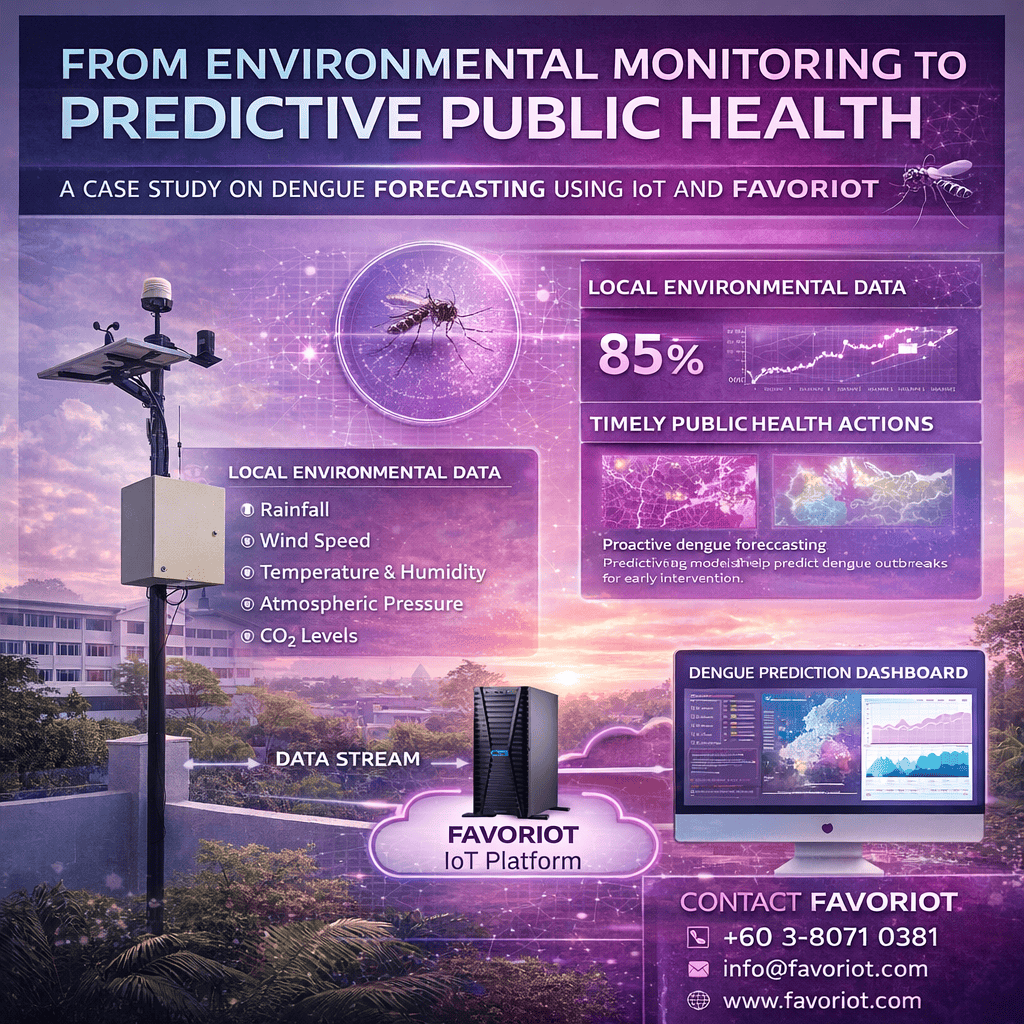
From Environmental Monitoring to Predictive Public Health: A Favoriot Case Study on Dengue Forecasting

This IoT Project Predicted Dengue Before It Happened – A Favoriot Success Story

March 27th, 2026 Posted by BLOG, HOW-TO, Internet of Things, IOT PLATFORM 0 thoughts on “This IoT Project Predicted Dengue Before It Happened – A Favoriot Success Story”

Introduction

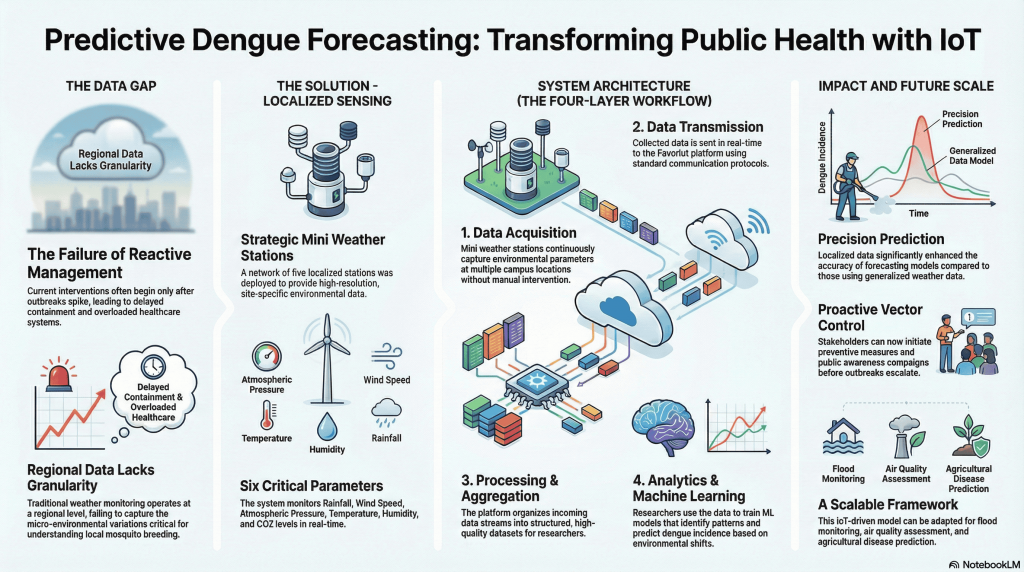
Dengue fever continues to pose a significant public health challenge in Malaysia and across many tropical regions. While efforts to manage outbreaks have improved over the years, most interventions remain reactive, often initiated only after cases begin to rise. This delay reduces the effectiveness of containment measures and increases the burden on healthcare systems.

What if outbreaks could be anticipated earlier?

What if environmental signals could be translated into actionable insights before infections spike?

This case study examines how a Malaysian university leveraged the Favoriot platform to enhance its research capabilities in predicting dengue outbreaks. By combining localised environmental monitoring with data analytics and machine learning, the university transitioned from general observation to data-driven prediction.

The Objective: Enabling Predictive Research

The university’s primary objective was to strengthen its research in dengue prediction by collecting localised environmental data. Rather than relying solely on generalised weather reports, the goal was to establish a system to capture real-time, site-specific environmental conditions that influence mosquito breeding and virus transmission.

This initiative aimed to:

  • Improve the accuracy of dengue prediction models
  • Provide researchers with high-quality, continuous datasets
  • Support early warning mechanisms for public health intervention

The Challenge: Limited Granularity in Environmental Data

One of the key challenges faced by the university was the lack of detailed and localised weather data.

Traditional weather monitoring systems typically operate at a regional level. While useful for general forecasting, they often fail to capture micro-environmental variations that are critical in understanding dengue dynamics.

Specifically, the university required:

  • High-resolution data across multiple locations
  • Real-time data availability for timely analysis
  • Integration of multiple environmental parameters in a single system

Without these capabilities, predictive modelling would remain limited in accuracy and reliability.

The Solution: Localised IoT-Enabled Weather Monitoring

To address these challenges, Favoriot deployed a network of mini weather stations across strategic locations within and around the university campus.

Each station was equipped with sensors capable of measuring:

  • Rainfall
  • Wind speed
  • Atmospheric pressure
  • Temperature
  • Humidity
  • Carbon dioxide levels

These stations continuously collected environmental data and transmitted it to the Favoriot IoT platform for centralised processing and analysis.

This approach ensured that data was collected at the source, providing a more accurate reflection of local environmental conditions.

System Architecture: From Data Acquisition to Insight

The overall system architecture can be described in four key layers:

1. Data Acquisition

Mini weather stations continuously capture environmental parameters at multiple locations. This ensures consistent and reliable data input without manual intervention.

2. Data Transmission

Collected data is transmitted in real time to the Favoriot platform using standard communication protocols, enabling immediate availability for analysis.

3. Data Processing and Aggregation

The Favoriot platform aggregates incoming data streams, organises them into structured datasets, and prepares them for analytical processing.

4. Analytics and Machine Learning

Researchers utilise the processed data to develop and train machine learning models. These models identify patterns and correlations between environmental conditions and dengue incidence, improving prediction accuracy over time.

Implementation: Structured Deployment and Data Utilisation

The implementation of the system followed a systematic approach:

  • Strategic Deployment: Five mini weather stations were installed in carefully selected locations to ensure optimal data coverage.
  • Continuous Data Collection: Sensors operated continuously, providing real-time environmental data streams.
  • Centralised Data Management: All data was ingested and managed through the Favoriot platform.
  • Research Integration: Data was made accessible to researchers for analysis, modelling, and validation of predictive algorithms.

This structured deployment ensured that the system was both scalable and aligned with the university’s research objectives.

Results: Measurable Improvements in Prediction and Response

The deployment delivered several key outcomes:

Improved Data Accuracy

Localised data collection significantly enhanced the precision of environmental measurements. This allowed researchers to work with more reliable datasets compared to traditional sources.

Enhanced Predictive Modelling

Machine learning models trained on high-quality, localised data demonstrated improved performance in predicting dengue outbreaks. The ability to capture micro-environmental variations contributed to more accurate forecasting.

Support for Proactive Public Health Measures

With improved prediction capabilities, stakeholders can initiate preventive actions earlier. This includes targeted vector control measures, public awareness campaigns, and resource allocation before outbreaks escalate.

Key Insights: Moving Beyond Data Collection

This case highlights an important shift in how IoT is applied in research and public health.

The value of IoT does not lie solely in data collection, but in its ability to:

  • Provide context-rich, localised data
  • Enable continuous monitoring
  • Support advanced analytics and predictive modelling
  • Drive informed decision-making

By connecting environmental data to actionable insights, the university elevated its research from observation to prediction.

Broader Implications: A Scalable Model for Other Domains

The approach demonstrated in this project can be extended beyond dengue prediction.

Similar frameworks can be applied to:

  • Flood monitoring and early warning systems
  • Air quality assessment in urban areas
  • Agricultural disease prediction
  • Urban climate analysis

In each case, the combination of localised sensing, real-time data processing, and intelligent analytics can significantly improve outcomes.

Conclusion

This case study demonstrates how integrating IoT and data analytics can enhance research capabilities and drive real-world impact.

By deploying localised weather stations and leveraging the Favoriot platform, the university successfully improved its ability to predict dengue outbreaks. The result is not only better research outcomes but also a stronger foundation for proactive public health strategies.

The transition from reactive response to predictive insight represents a meaningful step forward in managing complex health challenges.

For Further Inquiry

Organisations interested in developing similar solutions for environmental monitoring, predictive analytics, or smart city applications are encouraged to connect with Favoriot:

Engage with Favoriot to explore how data can be transformed into actionable intelligence for your specific use case.

A Favoriot Case Study

IoT in Museums: A Favoriot Success Story in Environmental Monitoring and Compliance

March 26th, 2026 Posted by BLOG, Internet of Things, IOT PLATFORM, NEWS, PRODUCT 0 thoughts on “IoT in Museums: A Favoriot Success Story in Environmental Monitoring and Compliance”

Executive Overview

Cultural institutions such as national museums carry a critical responsibility to preserve artefacts that represent a nation’s identity, history, and legacy. These artefacts are often fragile and highly sensitive to environmental conditions. Even minor fluctuations in temperature, humidity, or light exposure can lead to irreversible deterioration.

This case study examines how Favoriot, an AIoT platform provider, enabled a leading national museum to strengthen artefact preservation through continuous environmental monitoring, real-time alerts, and data-driven decision-making. The deployment highlights how IoT can move beyond basic data collection to deliver meaningful outcomes in heritage conservation.

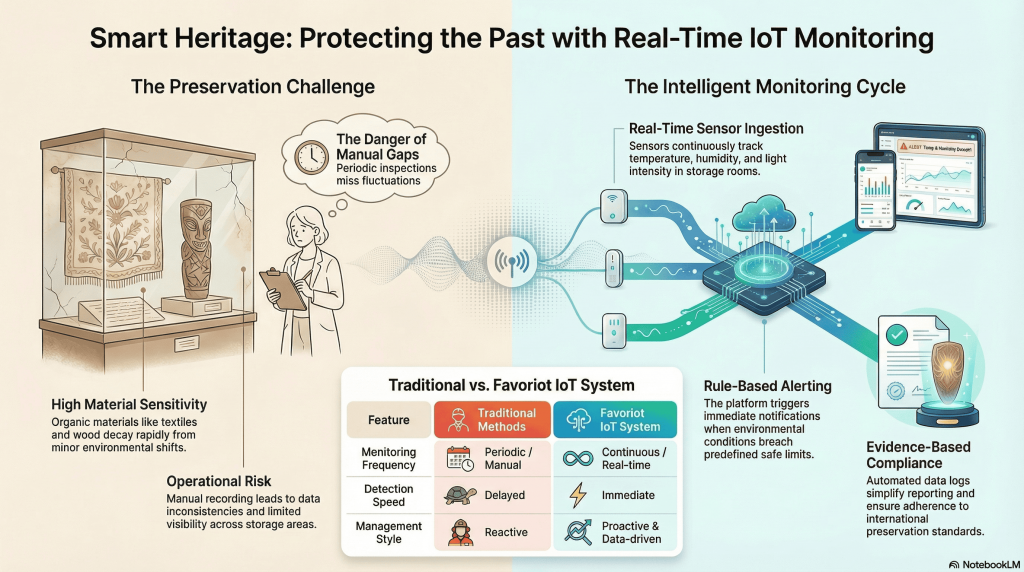
The Preservation Challenge

Museums operate under a constant and often underestimated threat. While catastrophic events are rare, the gradual impact of environmental instability poses a continuous risk.

Artefacts made from paper, textiles, wood, and organic materials are particularly vulnerable. Slight changes in humidity can result in mold or structural distortion. Temperature fluctuations can accelerate degradation. Exposure to inappropriate lighting conditions can cause fading and long-term damage.

Traditional preservation approaches typically rely on periodic inspections and standalone monitoring devices. These methods present several limitations:

  • Environmental changes may go undetected between inspection intervals
  • Manual recording can lead to inconsistencies
  • Limited visibility across storage areas
  • Challenges in maintaining accurate compliance records

As collections grow and preservation standards become more stringent, these limitations increase operational risk.

Objective of the Deployment

The museum aimed to establish a system capable of continuously monitoring environmental conditions within storage rooms where precious and priceless artefacts are preserved.

The key objectives included:

  • Real-time monitoring of temperature, humidity, and light levels
  • Immediate detection of deviations from safe thresholds
  • Automated alerts to support rapid corrective action
  • Centralised data management for analysis and reporting
  • Compliance with international preservation standards

The focus was clear. Protect the most valuable artefacts at their most critical location, the storage environment.

Solution Architecture

Favoriot deployed a Smart Environment Monitoring System using IoT sensors integrated with its platform.

Sensor Deployment in Storage Rooms

Environmental sensors were installed exclusively within storage rooms, where the most valuable and sensitive artefacts are kept.

These sensors continuously measured:

  • Temperature
  • Humidity
  • Light intensity

By focusing on storage areas, the system ensured that the highest-risk environments received constant and precise monitoring.

Data Transmission and Processing

Sensor data was transmitted in real time to the Favoriot platform. The platform enabled:

  • Continuous data ingestion and secure storage
  • Monitoring against predefined environmental thresholds
  • Rule-based alert generation
  • Visualisation through dashboards for operational awareness

Alert Mechanism

The system was configured to trigger alerts whenever environmental conditions moved outside safe limits. Notifications were sent directly to responsible personnel, enabling immediate intervention.

This ensured that corrective action could be taken before any damage to artefacts occurred.

Implementation Approach

The implementation followed a structured process:

  1. Identification of Critical Storage Areas
    Storage rooms housing high-value artefacts were prioritised.
  2. Sensor Installation and Calibration
    Devices were installed and calibrated to ensure accurate measurements.
  3. Platform Integration
    Sensors were connected to the Favoriot platform for centralised monitoring.
  4. Threshold Definition
    Acceptable environmental ranges were defined based on conservation standards.
  5. Alert Workflow Configuration
    Notification systems were established for rapid response.
  6. Training and Handover
    Museum staff were trained to interpret alerts and manage the system effectively.

Key Outcomes

The deployment delivered clear and measurable benefits:

1. Continuous Protection of Priceless Artefacts

Storage environments were monitored continuously, ensuring that artefacts remained within optimal preservation conditions at all times.

2. Faster Response to Environmental Changes

Real-time alerts enabled immediate corrective action, significantly reducing the risk of prolonged exposure to harmful conditions.

3. Structured Data Management

The system provided consistent and reliable data collection, allowing:

  • Historical trend analysis
  • Early identification of recurring issues
  • Data-driven decision-making

4. Strengthened Compliance and Accountability

The platform generated accurate environmental records, supporting compliance with international preservation standards and audits.

5. Improved Operational Focus

Automation reduced reliance on manual checks, allowing staff to focus on conservation and curatorial work.

From Monitoring to Preventive Protection

A key shift in this deployment is the transition from periodic inspection to continuous preventive protection.

Traditional systems often focus on recording conditions. This approach introduces delays between detection and response.

Favoriot enables:

  • Immediate detection of anomalies
  • Automated alerting mechanisms
  • Timely intervention before damage occurs

This transforms monitoring into an active safeguarding process.

Strategic Implications for Museums

This case highlights several important considerations for cultural institutions:

Continuous Monitoring is Essential

Periodic inspections alone cannot guarantee stable preservation conditions, especially for high-value artefacts stored in controlled environments.

Data Must Enable Action

Environmental data must be actionable. Without alert mechanisms and response workflows, its value is limited.

Evidence-Based Preservation Matters

Maintaining accurate records is critical for compliance, reporting, and institutional credibility.

Focus on High-Risk Areas

Targeting storage rooms where priceless artefacts are kept ensures that resources are directed to the most critical environments.

The Favoriot Value Proposition

Favoriot’s role in this project can be summarised through three core strengths:

  • Integrated Platform
    A unified system for monitoring, analytics, and alerting
  • Real-Time Responsiveness
    Immediate detection and notification of environmental deviations
  • Outcome-Focused Deployment
    Emphasis on protecting artefacts rather than simply displaying data

This approach aligns with the increasing demand for solutions that deliver measurable impact rather than standalone features.

Conclusion

Preserving cultural heritage requires continuous attention, precision, and reliability. Artefacts stored in controlled environments depend on stable conditions that must be maintained at all times.

Through its IoT-based Smart Environment Monitoring System, Favoriot enabled the museum to shift from reactive preservation practices to proactive environmental control, specifically in storage rooms where priceless artefacts are kept.

The result is enhanced protection, improved operational confidence, and stronger compliance with preservation standards.

This case demonstrates that when technology is applied with purpose, it becomes an essential safeguard for history itself.

The real question for cultural institutions is simple.

How long can priceless artefacts remain protected without a system that continuously watches over them?

Contact

Contact Favoriot for further inquiry.

Copyright © 2026 All rights reserved