Dengue fever continues to pose a significant public health challenge in Malaysia and across many tropical regions. While efforts to manage outbreaks have improved over the years, most interventions remain reactive, often initiated only after cases begin to rise. This delay reduces the effectiveness of containment measures and increases the burden on healthcare systems.
What if outbreaks could be anticipated earlier?
What if environmental signals could be translated into actionable insights before infections spike?
This case study examines how a Malaysian university leveraged the Favoriot platform to enhance its research capabilities in predicting dengue outbreaks. By combining localised environmental monitoring with data analytics and machine learning, the university transitioned from general observation to data-driven prediction.
The Objective: Enabling Predictive Research
The university’s primary objective was to strengthen its research in dengue prediction by collecting localised environmental data. Rather than relying solely on generalised weather reports, the goal was to establish a system to capture real-time, site-specific environmental conditions that influence mosquito breeding and virus transmission.
This initiative aimed to:
Improve the accuracy of dengue prediction models
Provide researchers with high-quality, continuous datasets
Support early warning mechanisms for public health intervention
The Challenge: Limited Granularity in Environmental Data
One of the key challenges faced by the university was the lack of detailed and localised weather data.
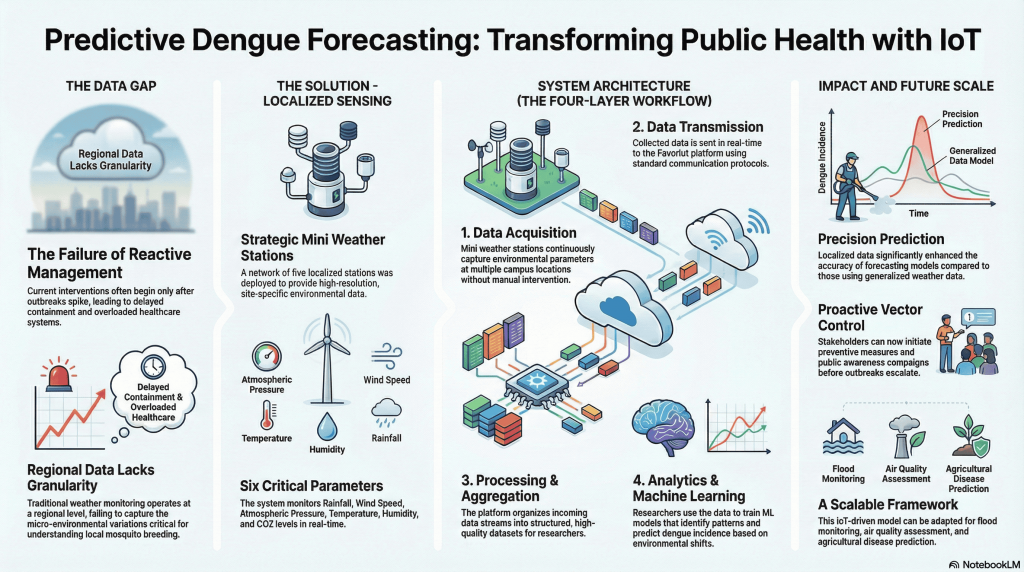
Traditional weather monitoring systems typically operate at a regional level. While useful for general forecasting, they often fail to capture micro-environmental variations that are critical in understanding dengue dynamics.
Specifically, the university required:
High-resolution data across multiple locations
Real-time data availability for timely analysis
Integration of multiple environmental parameters in a single system
Without these capabilities, predictive modelling would remain limited in accuracy and reliability.
The Solution: Localised IoT-Enabled Weather Monitoring
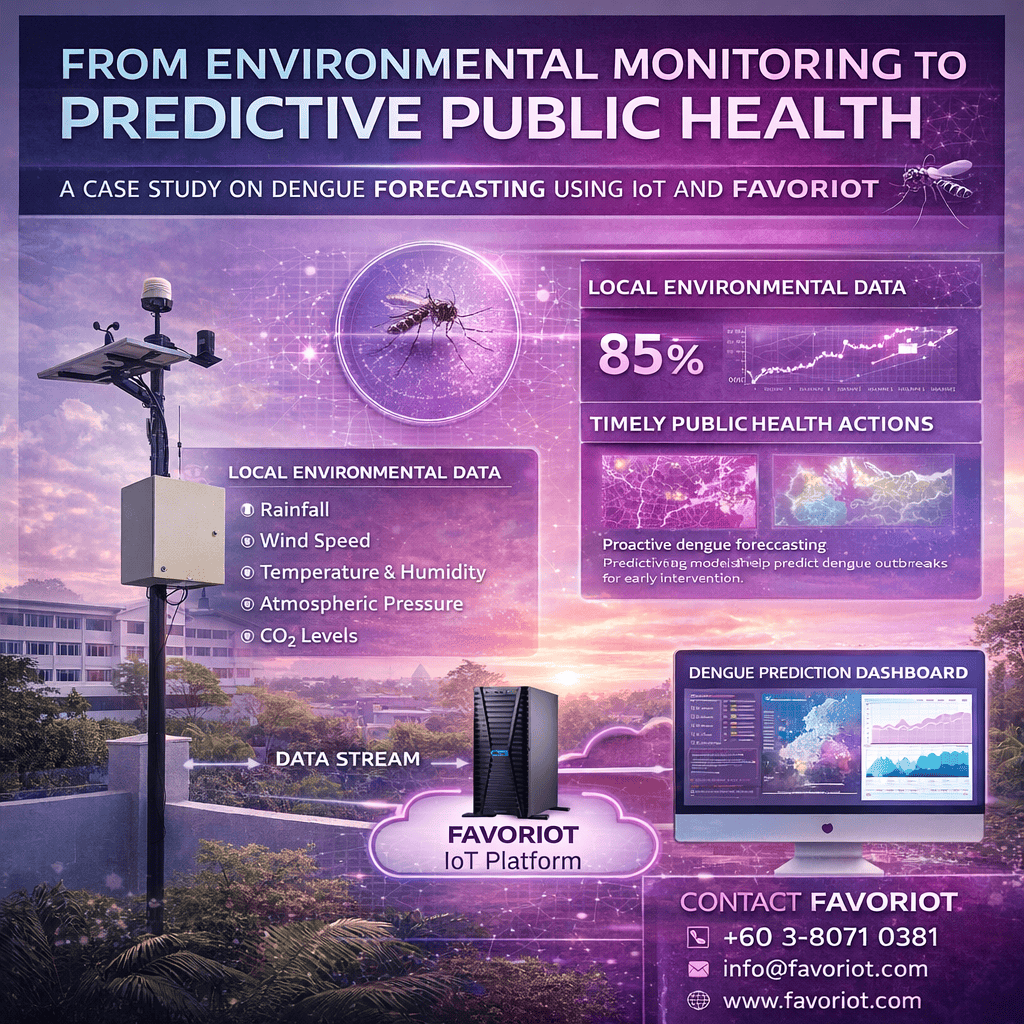
To address these challenges, Favoriot deployed a network of mini weather stations across strategic locations within and around the university campus.
Each station was equipped with sensors capable of measuring:
Rainfall
Wind speed
Atmospheric pressure
Temperature
Humidity
Carbon dioxide levels
These stations continuously collected environmental data and transmitted it to the Favoriot IoT platform for centralised processing and analysis.
This approach ensured that data was collected at the source, providing a more accurate reflection of local environmental conditions.
System Architecture: From Data Acquisition to Insight
The overall system architecture can be described in four key layers:
1. Data Acquisition
Mini weather stations continuously capture environmental parameters at multiple locations. This ensures consistent and reliable data input without manual intervention.
2. Data Transmission
Collected data is transmitted in real time to the Favoriot platform using standard communication protocols, enabling immediate availability for analysis.
3. Data Processing and Aggregation
The Favoriot platform aggregates incoming data streams, organises them into structured datasets, and prepares them for analytical processing.
4. Analytics and Machine Learning
Researchers utilise the processed data to develop and train machine learning models. These models identify patterns and correlations between environmental conditions and dengue incidence, improving prediction accuracy over time.
Implementation: Structured Deployment and Data Utilisation
The implementation of the system followed a systematic approach:
Strategic Deployment: Five mini weather stations were installed in carefully selected locations to ensure optimal data coverage.
Continuous Data Collection: Sensors operated continuously, providing real-time environmental data streams.
Centralised Data Management: All data was ingested and managed through the Favoriot platform.
Research Integration: Data was made accessible to researchers for analysis, modelling, and validation of predictive algorithms.
This structured deployment ensured that the system was both scalable and aligned with the university’s research objectives.
Results: Measurable Improvements in Prediction and Response
The deployment delivered several key outcomes:
Improved Data Accuracy
Localised data collection significantly enhanced the precision of environmental measurements. This allowed researchers to work with more reliable datasets compared to traditional sources.
Enhanced Predictive Modelling
Machine learning models trained on high-quality, localised data demonstrated improved performance in predicting dengue outbreaks. The ability to capture micro-environmental variations contributed to more accurate forecasting.
Support for Proactive Public Health Measures
With improved prediction capabilities, stakeholders can initiate preventive actions earlier. This includes targeted vector control measures, public awareness campaigns, and resource allocation before outbreaks escalate.
Key Insights: Moving Beyond Data Collection
This case highlights an important shift in how IoT is applied in research and public health.
The value of IoT does not lie solely in data collection, but in its ability to:
Provide context-rich, localised data
Enable continuous monitoring
Support advanced analytics and predictive modelling
Drive informed decision-making
By connecting environmental data to actionable insights, the university elevated its research from observation to prediction.
Broader Implications: A Scalable Model for Other Domains
The approach demonstrated in this project can be extended beyond dengue prediction.
Similar frameworks can be applied to:
Flood monitoring and early warning systems
Air quality assessment in urban areas
Agricultural disease prediction
Urban climate analysis
In each case, the combination of localised sensing, real-time data processing, and intelligent analytics can significantly improve outcomes.
Conclusion
This case study demonstrates how integrating IoT and data analytics can enhance research capabilities and drive real-world impact.
By deploying localised weather stations and leveraging the Favoriot platform, the university successfully improved its ability to predict dengue outbreaks. The result is not only better research outcomes but also a stronger foundation for proactive public health strategies.
The transition from reactive response to predictive insight represents a meaningful step forward in managing complex health challenges.
For Further Inquiry
Organisations interested in developing similar solutions for environmental monitoring, predictive analytics, or smart city applications are encouraged to connect with Favoriot:
ESG is no longer driven by intention statements or annual summaries. Today, organisations are expected to show evidence. Regulators want proof. Investors want consistency. Customers want transparency.
At the centre of this shift sits one critical enabler: IoT.
IoT transforms ESG reporting from a compliance obligation into an operational capability by capturing real-world data directly from assets, facilities, and environments. Without this layer of measurement, ESG metrics are often based on assumptions rather than facts.
ESG Needs Measured Reality, Not Estimates
Many organisations still depend on:
Periodic meter readings
Manual logs
Spreadsheets are updated once a quarter or once a year
These methods struggle to survive audits and increasingly fall short of modern disclosure expectations. ESG today demands data that is:
Continuous
Verifiable
Traceable to source
IoT fills this gap by collecting information automatically, consistently, and in real time.
How IoT Supports Each ESG Pillar
Environmental: Where IoT Plays the Largest Role
Environmental indicators are the most measurable and the most scrutinised. IoT enables direct monitoring of key environmental metrics such as:
Energy usage
Electricity consumption by machine, line, or facility
Peak demand and load behaviour
Renewable energy contribution
Emissions and air quality
CO₂ concentration
Particulate matter
Indoor air quality in controlled spaces
Water consumption
Inflow and discharge volumes
Leak detection
Process water usage
Waste tracking
Waste volumes
Recycling rates
Hazardous material handling
These measurements underpin carbon accounting, energy intensity reporting, and environmental risk management.
Social: Protecting People Through Data
IoT contributes to the Social pillar by improving visibility into workplace conditions, especially in operational environments.
Typical applications include:
Monitoring temperature and humidity on production floors
Detecting gas leaks or unsafe exposure levels
Identifying equipment conditions that could lead to accidents
In sectors such as manufacturing, construction, and energy, these indicators are closely linked to legal and ethical responsibilities.
Governance: Building Trust Through Data Integrity
Governance is not measured by sensors, but it depends on the quality of the data behind decisions.
IoT strengthens governance by:
Reducing manual intervention in data collection
Creating time-stamped, tamper-resistant records
Supporting audit readiness with clear data trails
When ESG figures are backed by operational data, governance moves from declarations to defensible accountability.
What ESG Monitoring Is Commonly Expected
While ESG rules vary by country and industry, several monitoring areas are widely treated as baseline requirements.
Area
ESG Pillar
Why It Matters
Energy consumption
Environmental
Carbon and efficiency metrics
Emissions data
Environmental
Climate-related disclosures
Water usage
Environmental
Resource risk and compliance
Pollution indicators
Environmental
Regulatory and community impact
Worker safety metrics
Social
Duty of care
Data traceability
Governance
Audit credibility
Organisations lacking reliable data in these areas often face delays, higher audit costs, and increased scrutiny.
Example: ESG Monitoring in a Manufacturing Factory
Consider a medium-sized factory operating multiple production lines.
Environmental Monitoring
Smart meters track electricity usage at:
Incoming power supply
Individual production lines
High-energy equipment such as compressors
Water flow sensors monitor:
Process water consumption
Cooling systems
Discharge points
Air quality sensors measure:
Indoor CO₂ levels
Particulate concentration
Ventilation effectiveness
This setup allows the factory to calculate energy intensity per unit produced, detect abnormal consumption early, and support environmental reporting with confidence.
Social Monitoring
Temperature and humidity sensors ensure safe working conditions
Gas detectors provide early alerts before exposure becomes dangerous
Equipment monitoring helps reduce accidents caused by malfunctioning machinery
This gives management visibility not just into outcomes, but also into actions taken when issues arise.
Turning IoT Data into ESG Insight
Raw sensor data alone is not enough. It must be structured, contextualised, and aligned with ESG indicators.
This is where an IoT platform becomes essential. Platforms like Favoriot help organisations manage data from multiple sensors, locations, and systems while presenting ESG-relevant insights through dashboards, alerts, and historical views. This makes ESG monitoring scalable across factories, buildings, and regions without adding operational complexity.
Closing Thoughts
ESG expectations continue to rise, and tolerance for estimates is shrinking.
IoT provides the foundation for:
Measurable environmental performance
Safer workplaces
Stronger governance backed by evidence
For organisations serious about ESG, monitoring is no longer optional. It is the starting point for trust, accountability, and long-term credibility.