How to Run an Operational Blindness Assessment
August 4th, 2026 Posted by favoriotadmin BLOG, HOW-TO, Internet of Things, Operational Blindness 0 thoughts on “How to Run an Operational Blindness Assessment”A Practical Framework for Identifying Hidden Operational Risks Before They Become Business Problems
Many organisations believe they have good visibility because they have invested in IoT devices, enterprise software, dashboards, and Artificial Intelligence. Control rooms are filled with screens, operational reports arrive daily, and key performance indicators appear healthy.
Yet equipment still fails unexpectedly. Service interruptions continue to occur. Response times remain slow. Decisions are delayed, and different departments often work with conflicting information.
These situations reveal a fundamental problem. The organisation is connected, but it is not truly visible.
Operational Blindness is the inability to detect, understand, coordinate, and respond to operational events quickly enough to maintain safe, efficient, and resilient operations. It is not simply a technology issue. It is a visibility issue.
An Operational Blindness Assessment (OBA) provides a systematic way to identify where these blind spots exist, measure their impact, and develop a roadmap for improving operational visibility.
Rather than asking, “Do we have enough technology?”, an Operational Blindness Assessment asks a far more valuable question:
“Can our organisation consistently see what is happening across its operations and respond before small issues become major problems?”
Why Every Organisation Needs an Operational Blindness Assessment
Operational Blindness develops gradually. Manual workarounds become accepted practices. Delayed reporting becomes normal. Teams rely on phone calls, emails, spreadsheets, or messaging groups to coordinate responses. Over time, these practices create hidden risks that are rarely visible until an incident occurs.
An Operational Blindness Assessment uncovers these weaknesses before they affect operational performance.
The assessment helps organisations:
- Identify invisible operational risks
- Measure decision delays
- Discover data and process gaps
- Evaluate cross-functional coordination
- Prioritise investments that improve operational visibility
- Establish a baseline for continuous improvement
Instead of focusing only on technology, the assessment evaluates how effectively the organisation converts operational data into timely action.
Step 1: Identify Critical Operations
The first step is determining which operations are essential to business continuity.
Every organisation has processes where failure carries significant operational, financial, regulatory, or safety consequences.
Examples include:
| Industry | Critical Operations |
|---|---|
| Water Utilities | Pump stations, reservoirs, pressure zones, water quality |
| Manufacturing | Production lines, critical machines, utilities |
| Smart Buildings | HVAC systems, lifts, energy management, indoor air quality |
| Healthcare | Cold-chain storage, medical gases, backup power |
| Energy | Substations, transformers, renewable energy assets |
| Smart Cities | Flood monitoring, traffic control, street lighting, waste collection |
These operations should become the primary focus of the assessment because improving visibility in these areas delivers the greatest operational value.
Step 2: Map the Operational Workflow
Technology diagrams rarely reflect how work actually gets done.
Instead, map the real operational workflow from the moment an event occurs until corrective action is completed.
A typical workflow includes:
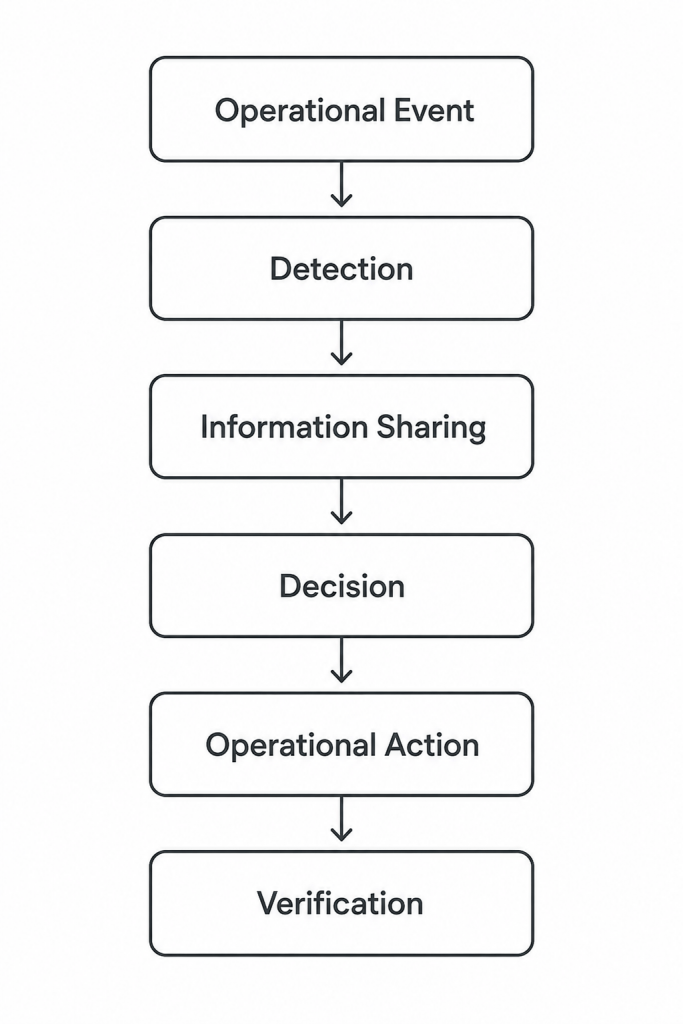
For each stage, ask:
- How is the event detected?
- Who receives the information?
- Is the information available immediately or after manual reporting?
- Who has authority to make decisions?
- How long does each stage take?
- What happens if the responsible person is unavailable?
Many organisations discover that their largest delays occur not because of missing technology, but because of inefficient operational processes.
Step 3: Locate Operational Blind Spots
Once workflows have been mapped, the next task is identifying where visibility is lost.
Common blind spots include:
Invisible Assets
Critical equipment operates without continuous monitoring, making failures difficult to detect until someone notices them manually.
Fragmented Information
Operational data is scattered across multiple systems that cannot communicate with one another.
Delayed Operational Reporting
Important information reaches decision makers long after the event has occurred.
Manual Communication
Operational coordination depends on phone calls, WhatsApp groups, spreadsheets, or paper records.
Lack of Operational Context
Data is available, but operators cannot easily determine whether conditions are normal or abnormal.
Unclear Ownership
No individual or team is responsible for monitoring specific operational conditions or responding when problems arise.
Each blind spot represents an opportunity to improve operational visibility.
Step 4: Evaluate the Five Layers of Operational Blindness
An effective assessment should examine operational visibility across five interconnected layers.
1. Data Blindness
Determine whether operational data is complete, accurate, and continuously available.
Questions include:
- Are all critical assets connected?
- Can missing or incorrect data be detected?
- Is operational data trusted by decision makers?
2. Context Blindness
Data alone is insufficient if people cannot interpret its meaning.
Assess whether operators understand:
- What normal operations look like
- Which conditions require attention
- How different operational events are related
Dashboards displaying numbers without operational context often create a false sense of confidence.
3. Decision Blindness
Evaluate how quickly operational decisions are made after an event is detected.
Look for indicators such as:
- Multiple approval layers
- Delayed escalation
- Uncertainty about responsibility
- Decisions based on assumptions rather than evidence
The longer the decision process, the greater the operational risk.
4. Coordination Blindness
Even when departments have access to the same information, poor coordination can delay action.
Assess whether:
- Teams share the same operational picture.
- Operational responsibilities are clearly defined.
- Information flows efficiently between departments.
- Responses are coordinated rather than duplicated.
Operational visibility is as much about collaboration as it is about technology.
5. Learning Blindness
The final layer examines whether the organisation learns from operational incidents.
Questions include:
- Are incidents investigated systematically?
- Are root causes documented?
- Are operational procedures updated?
- Are lessons shared across teams?
If similar incidents continue to occur, the organisation may be suffering from Learning Blindness.
Step 5: Measure the Decision Window
One of the most revealing parts of an Operational Blindness Assessment is measuring the Decision Window.
This is the time required to move from an operational event to a verified response.
A typical timeline is:
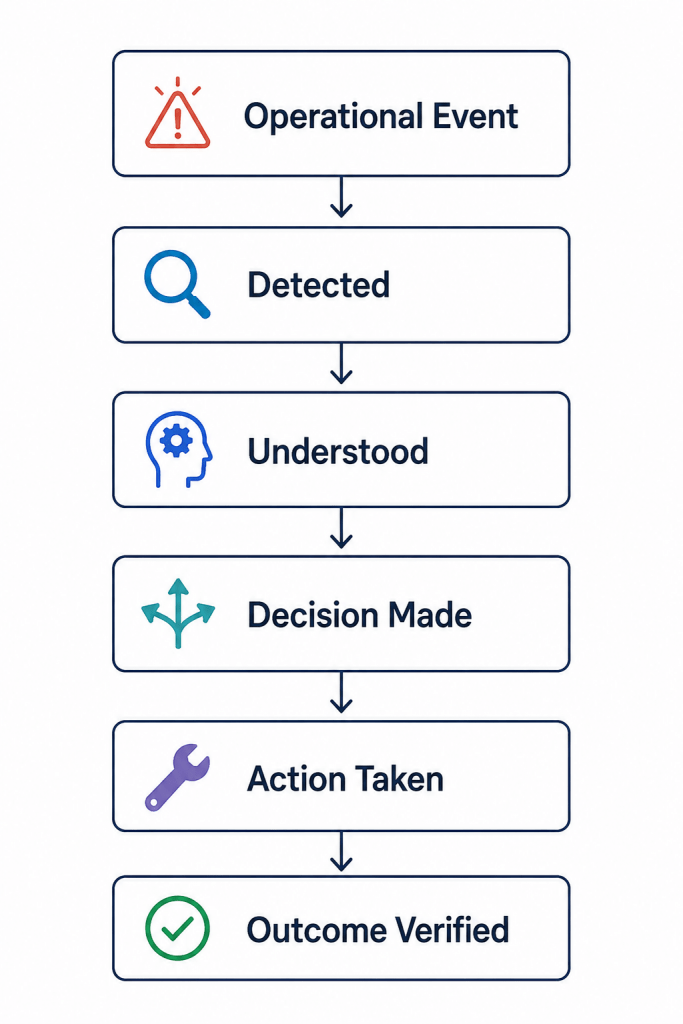
Instead of estimating, measure the elapsed time at every stage.
For example:
| Stage | Time |
|---|---|
| Event detection | 2 minutes |
| Investigation | 15 minutes |
| Decision approval | 30 minutes |
| Response execution | 20 minutes |
| Verification | 10 minutes |
Total Decision Window: 77 minutes
The next question is equally important:
Could this process have been completed in 10 or 15 minutes if better operational visibility existed?
The difference represents the cost of Operational Blindness.
Step 6: Calculate an Operational Blindness Index
The assessment findings can be converted into an Operational Blindness Index (OBI) that provides a measurable benchmark for improvement.
Typical assessment categories include:
- Visibility of critical assets
- Data quality and reliability
- Operational context
- Decision speed
- Cross-functional coordination
- Incident response
- Continuous learning
- Automation readiness
Each category can be scored using a five-point maturity scale.
An overall OBI score allows organisations to benchmark progress over time and compare operational maturity across different sites or departments.
Step 7: Build a Visibility Improvement Roadmap
The assessment should conclude with a practical action plan.
Rather than attempting to solve every issue simultaneously, prioritise improvements that deliver immediate operational value.
Typical recommendations include:
- Connect previously unmonitored critical assets.
- Replace manual reporting with automated data collection.
- Consolidate fragmented operational information into a unified view.
- Introduce real-time alerts for abnormal operating conditions.
- Clarify operational ownership and escalation procedures.
- Automate repetitive workflows where appropriate.
- Review operational incidents regularly and update response procedures.
Incremental improvements often produce significant gains in operational performance.
From Assessment to Operational Visibility
An Operational Blindness Assessment identifies where visibility is missing. The next step is addressing those gaps through an Operational Visibility Platform (OVP).
An OVP goes beyond collecting IoT data. It continuously connects assets, validates operational information, provides context, detects abnormal conditions, coordinates responses, and supports evidence-based decision making.
In simple terms, it helps organisations move from connected operations to visible operations, enabling faster decisions, stronger coordination, and greater operational resilience.
Seeing Clearly Is the First Step Toward Better Operations
Operational Blindness is not an abstract concept. It can be measured, analysed, and systematically reduced.
An Operational Blindness Assessment gives organisations a clear understanding of where they lack visibility, why operational decisions are delayed, and which improvements will have the greatest impact. It shifts the conversation away from buying more technology and toward building operational awareness.
As organisations continue investing in AI, automation, and connected infrastructure, the greatest competitive advantage will belong to those that can see their operations clearly, understand what those operations are telling them, and act before minor issues become major disruptions.
The journey towards Operational Visibility begins with a simple question:
“Where are we still operationally blind?”