
Introduction
Dengue fever continues to pose a significant public health challenge in Malaysia and across many tropical regions. While efforts to manage outbreaks have improved over the years, most interventions remain reactive, often initiated only after cases begin to rise. This delay reduces the effectiveness of containment measures and increases the burden on healthcare systems.
What if outbreaks could be anticipated earlier?
What if environmental signals could be translated into actionable insights before infections spike?
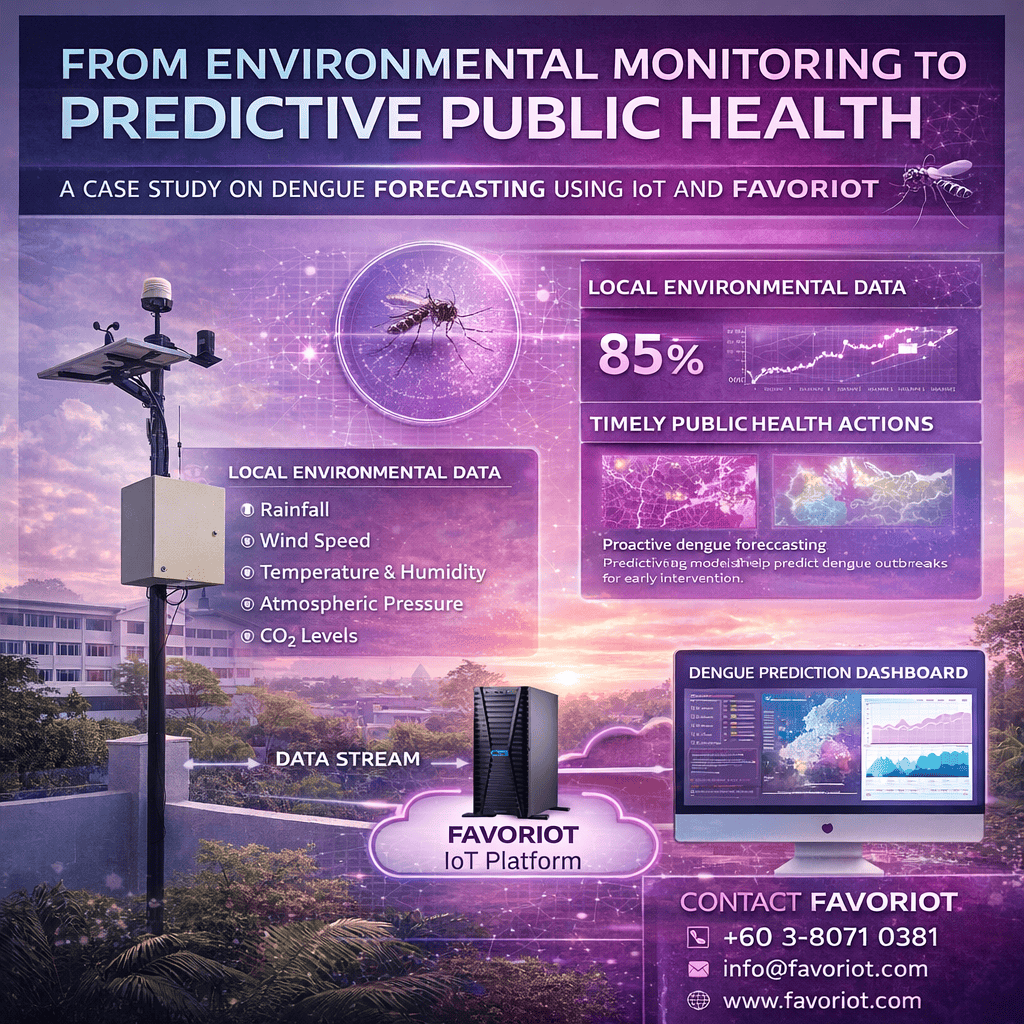
This case study examines how a Malaysian university leveraged the Favoriot platform to enhance its research capabilities in predicting dengue outbreaks. By combining localised environmental monitoring with data analytics and machine learning, the university transitioned from general observation to data-driven prediction.
The Objective: Enabling Predictive Research
The university’s primary objective was to strengthen its research in dengue prediction by collecting localised environmental data. Rather than relying solely on generalised weather reports, the goal was to establish a system to capture real-time, site-specific environmental conditions that influence mosquito breeding and virus transmission.
This initiative aimed to:
- Improve the accuracy of dengue prediction models
- Provide researchers with high-quality, continuous datasets
- Support early warning mechanisms for public health intervention
The Challenge: Limited Granularity in Environmental Data
One of the key challenges faced by the university was the lack of detailed and localised weather data.
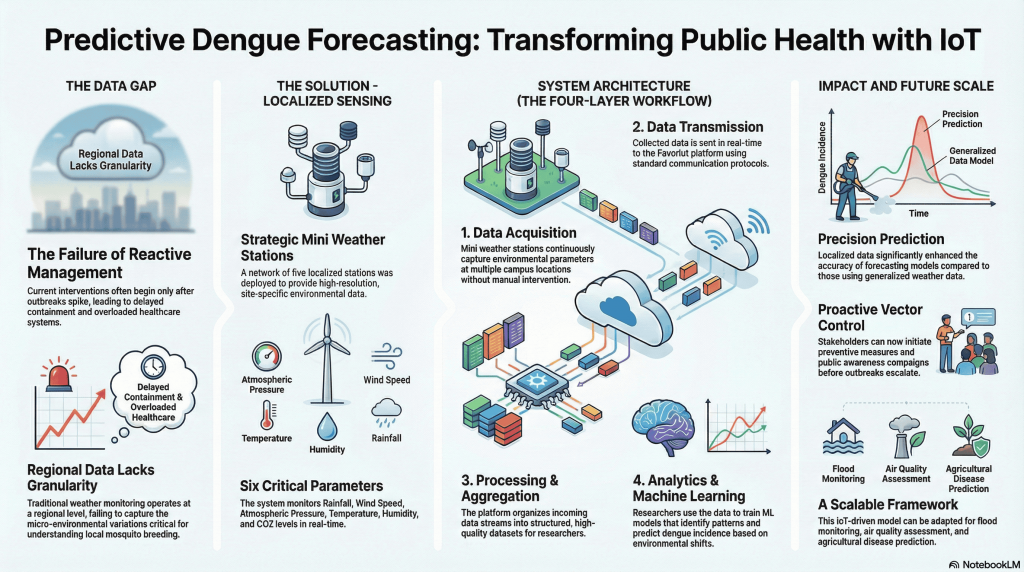
Traditional weather monitoring systems typically operate at a regional level. While useful for general forecasting, they often fail to capture micro-environmental variations that are critical in understanding dengue dynamics.
Specifically, the university required:
- High-resolution data across multiple locations
- Real-time data availability for timely analysis
- Integration of multiple environmental parameters in a single system
Without these capabilities, predictive modelling would remain limited in accuracy and reliability.
The Solution: Localised IoT-Enabled Weather Monitoring
To address these challenges, Favoriot deployed a network of mini weather stations across strategic locations within and around the university campus.
Each station was equipped with sensors capable of measuring:
- Rainfall
- Wind speed
- Atmospheric pressure
- Temperature
- Humidity
- Carbon dioxide levels
These stations continuously collected environmental data and transmitted it to the Favoriot IoT platform for centralised processing and analysis.
This approach ensured that data was collected at the source, providing a more accurate reflection of local environmental conditions.
System Architecture: From Data Acquisition to Insight
The overall system architecture can be described in four key layers:
1. Data Acquisition
Mini weather stations continuously capture environmental parameters at multiple locations. This ensures consistent and reliable data input without manual intervention.
2. Data Transmission
Collected data is transmitted in real time to the Favoriot platform using standard communication protocols, enabling immediate availability for analysis.
3. Data Processing and Aggregation
The Favoriot platform aggregates incoming data streams, organises them into structured datasets, and prepares them for analytical processing.
4. Analytics and Machine Learning
Researchers utilise the processed data to develop and train machine learning models. These models identify patterns and correlations between environmental conditions and dengue incidence, improving prediction accuracy over time.
Implementation: Structured Deployment and Data Utilisation
The implementation of the system followed a systematic approach:
- Strategic Deployment: Five mini weather stations were installed in carefully selected locations to ensure optimal data coverage.
- Continuous Data Collection: Sensors operated continuously, providing real-time environmental data streams.
- Centralised Data Management: All data was ingested and managed through the Favoriot platform.
- Research Integration: Data was made accessible to researchers for analysis, modelling, and validation of predictive algorithms.
This structured deployment ensured that the system was both scalable and aligned with the university’s research objectives.
Results: Measurable Improvements in Prediction and Response
The deployment delivered several key outcomes:
Improved Data Accuracy
Localised data collection significantly enhanced the precision of environmental measurements. This allowed researchers to work with more reliable datasets compared to traditional sources.
Enhanced Predictive Modelling
Machine learning models trained on high-quality, localised data demonstrated improved performance in predicting dengue outbreaks. The ability to capture micro-environmental variations contributed to more accurate forecasting.
Support for Proactive Public Health Measures
With improved prediction capabilities, stakeholders can initiate preventive actions earlier. This includes targeted vector control measures, public awareness campaigns, and resource allocation before outbreaks escalate.
Key Insights: Moving Beyond Data Collection
This case highlights an important shift in how IoT is applied in research and public health.
The value of IoT does not lie solely in data collection, but in its ability to:
- Provide context-rich, localised data
- Enable continuous monitoring
- Support advanced analytics and predictive modelling
- Drive informed decision-making
By connecting environmental data to actionable insights, the university elevated its research from observation to prediction.
Broader Implications: A Scalable Model for Other Domains
The approach demonstrated in this project can be extended beyond dengue prediction.
Similar frameworks can be applied to:
- Flood monitoring and early warning systems
- Air quality assessment in urban areas
- Agricultural disease prediction
- Urban climate analysis
In each case, the combination of localised sensing, real-time data processing, and intelligent analytics can significantly improve outcomes.
Conclusion
This case study demonstrates how integrating IoT and data analytics can enhance research capabilities and drive real-world impact.
By deploying localised weather stations and leveraging the Favoriot platform, the university successfully improved its ability to predict dengue outbreaks. The result is not only better research outcomes but also a stronger foundation for proactive public health strategies.
The transition from reactive response to predictive insight represents a meaningful step forward in managing complex health challenges.
For Further Inquiry
Organisations interested in developing similar solutions for environmental monitoring, predictive analytics, or smart city applications are encouraged to connect with Favoriot:
- Email: info@favoriot.com
- Phone: +60 3-8071 0381
- Website: www.favoriot.com
Engage with Favoriot to explore how data can be transformed into actionable intelligence for your specific use case.