Malaysia Operational Visibility 2026: An Industry Perspective
July 29th, 2026 Posted by favoriotadmin BLOG, Internet of Things, IOT PLATFORM, Operational Blindness 0 thoughts on “Malaysia Operational Visibility 2026: An Industry Perspective”
Malaysia Operational Visibility 2026: An Industry Perspective
Executive Summary
Malaysia is becoming a highly connected economy. Factories install sensors. Buildings have management systems. Utilities collect meter readings. Local councils operate command centres. Companies publish sustainability reports. Farms monitor weather and soil conditions.
On paper, Malaysia appears to have plenty of data. Yet many organisations still do not know what is happening across their operations until somebody makes a call, sends a WhatsApp message, opens a spreadsheet or travels to the site.
This is Operational Blindness: the gap between what an organisation collects and what its people can actually see, trust and act on.
Malaysia is not short of technology spending. ICT and e-commerce contributed RM451.3 billion to the economy in 2024 [1]. The harder question is whether that spending helps organisations detect problems earlier, understand conditions across sites, reduce waste and prove that reported performance matches reality.
The 2026 assessment identifies seven hotspots: water and utilities, manufacturing, buildings, flood and environmental monitoring, agriculture, local government and ESG reporting. Malaysia does not need another wave of isolated dashboards. It needs a stronger connection between data, visibility, responsibility and action.
1. What Operational Blindness Means
Operational Blindness is the inability to continuously see, understand and respond to conditions across physical operations. It appears when an organisation owns data, systems and dashboards, yet still depends on telephone calls, WhatsApp messages, spreadsheets or site visits to find out what is happening.
An organisation can be digitally advanced and still operationally blind. A factory may use AI in the head office while technicians still write readings on paper. A city may have a command centre while departments keep separate databases. A building may have a Building Management System while energy, air quality, occupancy and maintenance records remain disconnected.
The presence of technology does not automatically create visibility. Visibility exists only when trusted data reaches the right person, in time, with a clear response attached.
2. Malaysia’s Position in 2026
Malaysia enters 2026 with strong national ambitions in digitalisation, AI, industrial automation and sustainability. ICT and e-commerce contributed 23.4% or RM451.3 billion to Malaysia’s economy in 2024, growing 5.1% compared with 3.5% in the previous year [1]. Malaysia Digital investments also continued to attract capital and new digital companies [2].
The New Industrial Master Plan 2030 targets the transformation of 3,000 smart factories by 2030 [3]. Malaysia’s National Sustainability Reporting Framework is pushing companies towards more consistent, comparable and reliable sustainability disclosures [4][5].
These programmes create a large opportunity, but they also expose a basic weakness. AI, predictive analytics and credible ESG reporting depend on continuous, trustworthy operational data. Where field data is incomplete, delayed or fragmented, advanced analytics will produce confident answers from an incomplete picture.
3. Seven Operational Blindness Hotspots
3.1 Water and Utility Management
HighWater losses, distributed assets and incomplete field visibility
Water management is one of the clearest examples. Malaysia’s national non-revenue water rate was reported at 37.1% in 2023, representing about 7,195 million litres of treated water lost each day and more than RM2 billion in annual losses [6].
The visibility gap often lies between production meters, district meters, customer meters and maintenance records. A pipe can leak underground for weeks while the control room still appears normal.
Priority actions include pressure monitoring, district metering, reservoir-level monitoring, pump-condition monitoring, abnormal consumption alerts and better connection between telemetry and field maintenance. Air Selangor reported reducing non-revenue water from 33.2% in 2017 to 27.8% in 2023, showing what sustained measurement and intervention can achieve [7].
3.2 Manufacturing and Industrial Operations
High for SMEs; Moderate for larger plantsLegacy machinery, isolated control systems and manual inspection
Malaysia’s smart-factory target will increase demand for machine connectivity, energy monitoring, production visibility and condition-based maintenance [3]. Yet many factories still operate with a mixture of legacy machines, standalone PLCs, handwritten forms, vendor portals and spreadsheets.
Management may know total daily production but not which machine consumes too much energy, which motor shows abnormal vibration, why a line stopped, or how long equipment operated outside its recommended range.
Favoriot should complement, not replace, safety-critical SCADA and control systems. The operational visibility layer can connect selected machine, meter and sensor data for wider analysis, alerting and management reporting.
3.3 Buildings and Facilities
HighSeparate BMS, energy, maintenance and tenant systems
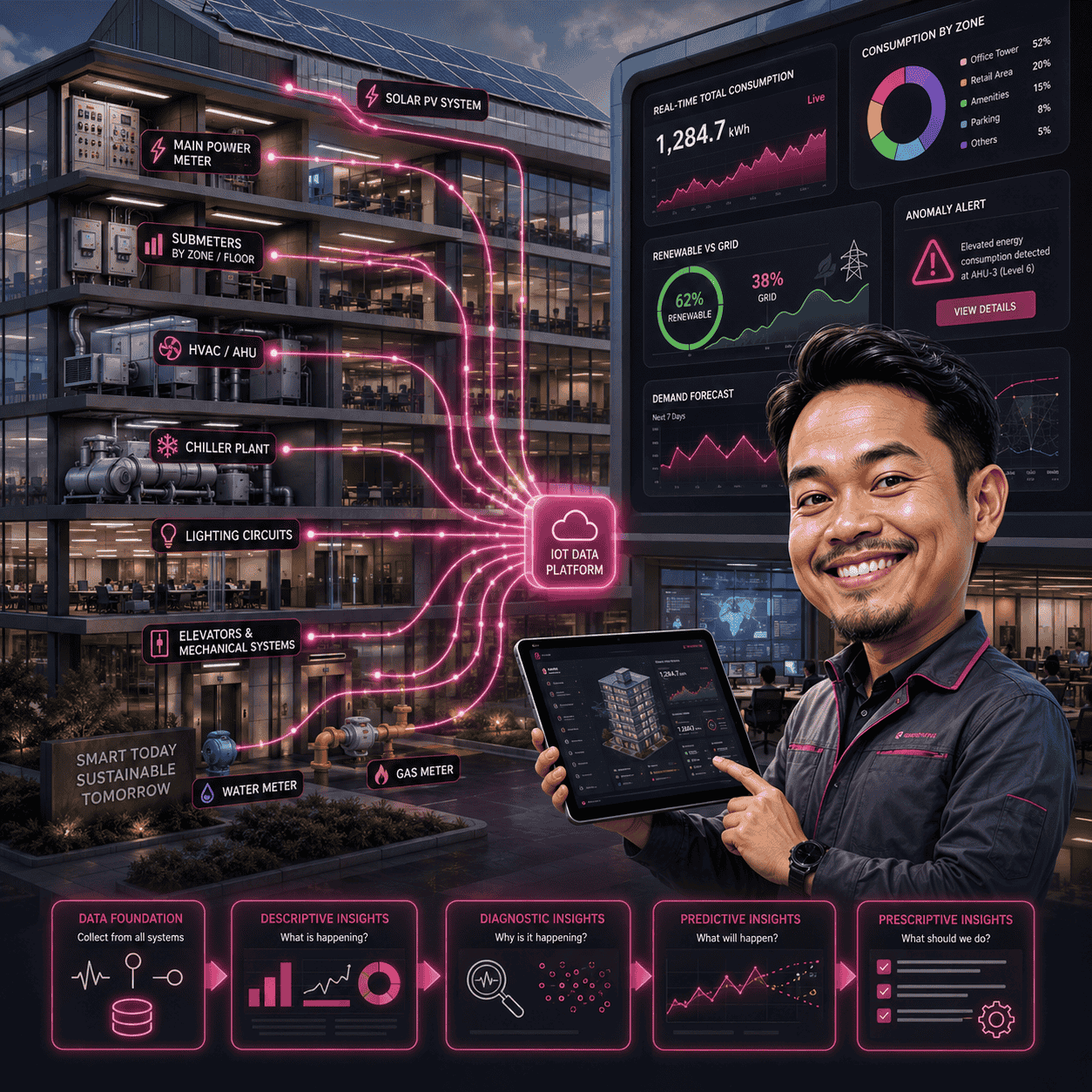
Many Malaysian buildings have a Building Management System, yet owners still lack one view of electricity, indoor air quality, cooling performance, water usage, occupancy, lifts, pumps and maintenance.
Common symptoms include unusually high electricity bills without a clear cause, air-conditioning running in empty areas, water leaks discovered through complaints and maintenance based on fixed schedules instead of equipment condition.
The strongest business case is not the phrase smart building. It is lower operating cost, fewer complaints, earlier fault detection and less unplanned maintenance.
3.4 Flood, Environment and Disaster Monitoring
Moderate to HighRemote sensing points and multi-agency coordination
Malaysia recorded 1,345 flood incidents in 2024, compared with 809 in 2023 [8]. Flood-related losses were estimated at RM933.4 million in 2024 and RM636.9 million in 2025 [9].
The challenge is not simply the lack of weather reports. It is knowing what is happening at a specific river, drain, road, village or pump station at the right moment, and getting that information to the party responsible for action.
Useful capabilities include river and drain-level monitoring, rainfall sensing, pump status, road-water detection, CCTV verification, automatic alert escalation and equipment-health monitoring at remote stations.
3.5 Agriculture and Plantations
HighRemote sites, weak connectivity and manual reporting
Agricultural operations are spread across wide areas. Managers often rely on workers to report soil moisture, irrigation failures, pump status, fertiliser levels, weather and crop conditions.
The value is not the sensor by itself. The value comes from a useful warning such as: Irrigation Zone 4 has not received enough water during the last six hours, and soil moisture is approaching the crop stress threshold.
Priority applications include irrigation and fertigation monitoring, water-storage levels, pump condition, microclimate monitoring, cold-chain tracking and satellite-connected monitoring for remote areas.
3.6 Local Government and City Operations
HighDepartmental silos, long procurement and unclear ownership
A city does not become operationally visible because it has a large video wall. Visibility must reach the officers repairing streetlights, clearing drains, collecting waste, maintaining facilities and responding to complaints.
City-wide platform programmes often slow down because of separate budgets, legacy systems, shifting priorities, data ownership questions and no single operational owner.
A more practical starting point is one measurable problem: reduce streetlight repair time, monitor flood-prone drains, track pump availability, improve public toilet maintenance or measure response time to complaints.
3.7 ESG and Sustainability Reporting
Moderate, rising quicklyReported precision exceeds the quality of field data
The National Sustainability Reporting Framework is raising expectations for consistent, comparable and reliable sustainability information [4][5]. Yet much of the underlying data still comes from bills, spreadsheets, estimates, contractor reports and annual surveys.
This creates a risk that the sustainability report becomes more precise than the operation. A company may publish an exact carbon figure while individual buildings still rely on estimated consumption.
The next stage of ESG maturity requires automated energy and water collection, emissions monitoring, site-level evidence, digital audit trails and alerts when performance exceeds thresholds.
4. Five Root Causes
1. Data silos
Different departments procure separate systems that rarely share information.
2. Manual reporting
Employees collect readings, prepare spreadsheets and email reports, creating delay and error.
3. Technology without ownership
Sensors and dashboards are installed without naming who must respond.
4. Project-based procurement
Support, calibration, connectivity and maintenance weaken after the project ends.
5. Management-only dashboards
Monthly summaries look neat but do not help field teams act in time.
5. Malaysia 2026 Risk Assessment
The assessment below is directional. It helps leaders prioritise investigation and is not an official national ranking.
| Sector | Blindness Risk | Main Reason |
|---|---|---|
| Water utilities | High | Large networks, leakage and incomplete field visibility |
| Manufacturing SMEs | High | Legacy equipment and manual monitoring |
| Large manufacturers | Moderate | Better automation, but systems remain fragmented |
| Commercial buildings | High | Separate building, energy and maintenance systems |
| Agriculture and plantations | High | Remote assets and delayed field reporting |
| Local government | High | Departmental silos and complex ownership |
| Flood management | Moderate to High | Multi-agency coordination and remote monitoring |
| Energy utilities | Moderate | Strong central monitoring but uneven asset-level visibility |
| Listed companies’ ESG reporting | Moderate | Growing reporting pressure and fragmented source data |
| Healthcare facilities | Moderate to High | Many critical systems with separate monitoring arrangements |
| Logistics and cold chain | Moderate to High | Gaps between warehouse, vehicle and customer systems |
6. The Cost of Operational Blindness
Operational Blindness creates two layers of cost. The first is easy to recognise because it appears in bills, repairs, downtime and losses. The second is harder to trace because it is buried inside delays, duplicated work, weak decisions and management time.
| Visible Costs | Hidden Costs |
|---|---|
| Water and energy waste | Delayed decisions |
| Equipment breakdown | Repeated site visits |
| Production downtime | Low trust in reports |
| Rejected products | Duplicate data entry |
| Emergency repairs | Disputes between departments |
| Environmental penalties | Slow investigations |
| Lost inventory | Poor customer experience |
| Property damage | Weak sustainability evidence |
| Staff overtime | Management time spent searching for information |
7. A Practical Response Playbook
1. Identify the blind spot
Ask which assets fail without warning, which readings are manual, which incidents arrive through WhatsApp, and which figures cannot be traced to a sensor or meter.
2. Start with a measurable use case
Choose a problem with a clear owner, visible cost or risk, available data and a practical response procedure.
3. Connect existing systems first
Reuse meters, PLCs, SCADA, BMS, sensors and databases where possible instead of replacing everything.
4. Design the alert-to-action process
Every alert must say what happened, where it happened, who must respond and what happens when nobody responds.
5. Measure operational outcomes
Track detection time, response time, downtime, site visits, resource savings, reporting hours and incidents prevented.
6. Expand after proof
Scale to other sites and functions after the first use case demonstrates operational value.
8. The Role of an Operational Visibility Platform
An Operational Visibility Platform acts as a shared layer between physical operations and the people who manage them. It can collect information from sensors, meters, industrial controllers, gateways, building systems, databases, third-party platforms and mobile applications.
The platform should not replace every application. Its role is to reduce the gaps between them and give teams a common operational picture.
9. Why Choose Favoriot
9.1 Built for Operational Visibility
Favoriot is designed to shorten the gap between an operational event and the response that follows. It brings device data, trends, alerts and multi-site views into one shared layer so technical teams and management can work from the same operational picture.
9.2 Works With Existing Systems
Organisations do not need to discard working investments. Favoriot can receive data from sensors, smart meters, gateways, PLC-connected systems, SCADA, BMS, LoRaWAN networks, MQTT services, REST APIs and enterprise databases. This supports phased modernisation instead of an expensive rip-and-replace exercise.
9.3 From Data to Timely Action
Favoriot combines data ingestion, dashboards, historical trends, rules, alerts and APIs. The purpose is not simply to display readings. It is to help teams detect abnormal conditions earlier, assign responsibility and respond before a small issue becomes an expensive incident.
9.4 Suitable for Multi-Site Operations
A single organisation may operate factories, buildings, farms, utility assets or remote facilities across many locations. Favoriot provides a common view while allowing each site, department or customer to see the information relevant to its role.
9.5 Cloud or On-Premises Deployment
Customers can select cloud deployment for faster rollout or an enterprise on-premises model when data residency, internal governance or private infrastructure is required.
9.6 Open APIs and Interoperability
Favoriot supports open connections to third-party devices and business applications. This reduces dependence on a single hardware supplier and allows operational data to support reporting, mobile applications, maintenance workflows, analytics and AI.
9.7 Trusted Operational Data for ESG and AI
ESG reporting and AI applications both depend on reliable field data. Favoriot can provide time-stamped records from meters, sensors and operational assets, helping organisations replace estimates and fragmented spreadsheets with traceable evidence.
9.8 Malaysian Expertise with Global Reach
Favoriot was developed in Malaysia and supports a community spanning more than 140 countries. Its experience covers government, enterprises, universities, system integrators, product developers and technology partners.
9.9 Start With One Blind Spot
The recommended approach is practical: identify one costly blind spot, connect the available data, define the alert-to-action process and measure the result. Once the first use case proves its value, the same platform can expand to more assets, sites and departments.
10. Outlook 2026-2029
Sustainability reporting
Companies will require more reliable environmental and climate data as the NSRF matures [4][5].
Smart-factory expansion
The 3,000 smart-factory target will raise demand for machine, energy and production data [3].
Rising utility costs
Organisations will need to find where resources are consumed or lost.
Climate and environmental risk
Floods and compliance needs will raise demand for continuous monitoring [8][9].
AI adoption
Useful AI depends on complete and trustworthy operational data.
Malaysia has spent years connecting people, businesses and government services. The next challenge is to connect the physical operation. Machines must reveal their condition. Buildings must show where resources are wasted. Water systems must expose losses. Farms must warn managers before crops are stressed. Sustainability reports must be supported by measured evidence.
References
- Department of Statistics Malaysia, Malaysia Digital Economy 2025. https://www.dosm.gov.my/portal-main/release-content/malaysia-digital-economy-2025
- Malaysia Digital Economy Corporation, Malaysia Digital Investments Accelerates AI Nation by 2030. https://www.mdec.my/media-release/news-press-release/411/mdec%E2%80%99s-malaysia-digital-investments-accelerates-ai-nation-by-2030
- New Industrial Master Plan 2030, Mission-based Project: Transform 3,000 Smart Factories. https://www.nimp2030.gov.my/index.php/pages/view/110?mid=461
- Securities Commission Malaysia, National Sustainability Reporting Framework. https://www.sc.com.my/nsrf
- Securities Commission Malaysia, National Sustainability Reporting Framework to Enhance Sustainability Disclosures. https://www.sc.com.my/resources/media/media-release/national-sustainability-reporting-framework-to-enhance-sustainability-disclosures
- Ministry of Energy Transition and Water Transformation, Water Loss Asia 2024 Address. https://www.petra.gov.my/uploads/content-downloads/file_20250326115534.pdf
- Air Selangor Hydro Hub, Sustainable Water Management Practices Aimed at Reducing Water Loss. https://hydrohub.airselangor.com/publication/air-selangors-sustainable-water-management-practices-aimed-at-reducing-water-loss/
- National Disaster Management Agency, Flood Incidents Jump Sharply in 2024. https://www.nadma.gov.my/bi/media-en/news/5921-flood-incidents-jump-sharply-in-2024-amid-climate-impacts-dosm-finds
- National Disaster Management Agency, Malaysia Flood Damage Bill for 2024 and 2025. https://www.nadma.gov.my/bm/media-2/berita/6320-flood-losses-ease-malaysia-s-damage-bill-drops-from-rm933-4m-in-2024-to-rm636-9m-in-2025
- Malaysia Digital Economy Corporation, Malaysia Digital. https://mdec.my/malaysiadigital
- MyDIGITAL, Malaysia Digital Economy Blueprint and National Digital Direction. https://www.mydigital.gov.my/
- Favoriot, Operational Visibility Platform and IoT Platform Information. https://www.favoriot.com/
Contact Favoriot
Discuss your operational blind spots and possible pilot use cases.
Email: info@favoriot.com
Website: www.favoriot.com